Visual evidence





Why SEMiCOM matters
SEMiCOM is exactly the sort of company that disappears if arcade history is reconstructed only from famous Japanese manufacturers, U.S. distributors, or the game lists preserved in Western magazines. Its catalog was large enough to matter, technically ambitious enough to require serious hardware work, and unusual enough that preservationists are still identifying boards, dumping protected games, and untangling product identities decades later.
The strongest period evidence for SEMiCOM's significance comes from Electronic Times in 1998. A November article on the expanding position of domestically produced Korean arcade games named SEMiCOM and its representative, Jeon Jae-yeon, among companies actively producing sports and puzzle games for a market increasingly interested in lower-cost domestic machines. A December industry survey went further: it estimated that South Korea had around sixty arcade-game developers, but said only a much smaller number were genuine original developers and fewer than ten could also design hardware boards. SEMiCOM was specifically named among roughly five or six companies then able to design and commercialize their own 2-D arcade boards. [S1][S2]
That contemporary description is important because the surviving games can otherwise give a misleading impression. Many SEMiCOM titles openly borrow genres, structures, visual ideas, or design vocabulary from better-known games. Some are close enough to famous titles that later writers have dismissed the company as a clone maker. Yet the hardware evidence, recurring staff credits, protection systems, custom boards, and period trade reporting show that "clone maker" is too simple. SEMiCOM could imitate, but it could also engineer.
The company is also a useful case study in how arcade history survives. Some titles are represented by dumped ROM sets. Others survive only through screenshots, flyers, advertisements, or scattered web pages. One 1998 SEMiCOM quiz target entered MAME temporarily under an unknown placeholder before being identified as Date Quiz Go Go. Another product, Red Wyvern, is known but still cannot be cleanly classified as a distinct sequel or an update to Wyvern Wings. Rolling Crush was once so poorly identified that physical PCB features, ROM strings, protection extraction, hidden end credits, and staff names had to be combined to establish its SEMiCOM origin. [S3][S4]
For Arcade Side B, those imperfections are part of the story rather than something to hide.
Market proof: SEMiCOM was not merely present, it was selling
One of the risks in researching a company like SEMiCOM is confusing survival in an emulator database with commercial importance. A board can be preserved even if it barely reached the market, while a domestically successful machine can become nearly invisible outside its home country. Contemporary Korean material helps correct that imbalance.
A November 24, 1998 Electronic Times article did not describe SEMiCOM as a marginal curiosity. It identified Jeon Jae-yeon as the company's representative and said SEMiCOM had been actively developing sports and puzzle games. More importantly, it said that SEMiCOM had scored consecutive hits that year with the card game Suhoseong and the quiz game Date Quiz Go Go, both positioned in the roughly 300,000-won price range. The article framed those lower-cost Korean machines as part of a wider shift in a difficult domestic arcade market: operators facing weaker customer traffic were increasingly interested in medium- and low-priced products with clear earning potential. [S1]
That description gives Suhoseong and Date Quiz Go Go a different historical weight. They were not just things SEMiCOM manufactured; they were products contemporary trade press considered successful enough to name when explaining why domestic Korean arcade games were gaining ground.
The date of Suhoseong has caused confusion because that 1998 article says SEMiCOM had hits "this year" with the game. Current MAME-derived preservation records place Suhoseong in 1997, and a later official-industry retrospective helps reconcile the two.
The 2002 Korea Game White Paper includes a table of major arcade products and the number of certification/approval tags issued by year. In its 1997 section, Suhoseong appears with a figure of 7,000. The surrounding notes make clear that the table is based on certification issuance rather than a simple audited retail-sales count, so Arcade Side B should not call the number "7,000 sales." But it is still a valuable market-distribution indicator, and it independently anchors the game in 1997. [S18]
The cleanest interpretation is therefore:
- Suhoseong is a 1997 product in the controlled chronology.
- Korean certification data associates it with 7,000 issued certifications/units in the 1997 table.
- By late 1998, Electronic Times still regarded it as one of SEMiCOM's recent successful low-cost products.
That is stronger—and more interesting—than forcing one source to cancel the other.
The same contemporary press also helps explain SEMiCOM's business strategy. The 1998 Korean arcade market was under pressure, and the article specifically describes operators moving toward lower-priced machines with straightforward ideas and dependable earning potential. SEMiCOM's puzzle, quiz, card, and sports output fits that environment extremely well. Its catalog starts to look less random when placed against what Korean operators were actually buying.
This is one reason the Arcade Side B article should resist a purely genre-by-genre reading of the company. SEMiCOM was making products for a local commercial ecosystem in which price, board cost, cabinet reuse, simple rules, and fast operator payback mattered. The company's repeated use of puzzle, sports, quiz, and compact action formats was not necessarily a failure of ambition. It was also a rational response to the market it served.
The beginning: Cheil Computer System, First Amusement, Mijin, and SEMiCOM
The most tempting version of SEMiCOM's origin story is a neat corporate progression: Cheil Computer System became First Amusement, First became Mijin Computer, and Mijin became SEMiCOM. That sequence appears in later Korean summaries, and the personnel and game-development trail makes some kind of continuity very plausible. But the surviving evidence does not yet justify treating all four names as proven successive legal identities.
Arcade Side B therefore separates two questions.
The first is the development lineage. Here the evidence is strong. Final Tetris appeared in 1993 under Cheil Computer System. Metal Saver followed in 1994 under First Amusement. Staff and production connections continue into SEMiCOM's earliest games, and current MAME source contains an especially revealing technical breadcrumb: Magicball Fighting retains unused Metal Saver graphics carrying the 1994 First Amusement copyright. That is difficult to explain without direct continuity of development material or personnel. [S28]
The second question is the legal corporate chain. That remains less certain. Mijin Computer, in particular, appears in early game records as a publisher, registrant, copyright holder, or manufacturer. Current MAME source says SEMiCOM used the Mijin name through 1995, and SEMiCOM's own indexed historical works material includes Wonder League Star, a game carrying Mijin presentation. That is enough for Arcade Side B to include Wonder League Star in the SEMiCOM development portfolio, but not enough to declare Mijin and SEMiCOM the same legal corporation without qualification. [S28]
The result is a more careful origin story: a Jeon Jae-yeon-centered development lineage can be followed from the 1993–94 Cheil/First period into SEMiCOM, while the exact ownership, incorporation, and name-change relationships among Cheil, First Amusement, Mijin Computer, and SEMiCOM remain open for formal registry proof.
This distinction also protects the game count. Arcade Side B's strict total begins with games developed as SEMiCOM products, while Final Tetris and Metal Saver are preserved as predecessor-lineage titles rather than retroactively counted as SEMiCOM releases.
1994–1995: the SEMiCOM name takes shape
The earliest confirmed SEMiCOM release in the strict census is Magic Ball Fighting from 1994. It is significant not because it became an international classic—it did not—but because it sits directly on the seam between First Amusement and SEMiCOM. The unused Metal Saver material inside the game's data makes it one of the best technical clues to continuity between the two development identities.
The following year produced the first real cluster of recognizable SEMiCOM output.
Wonder League Star: Sok-Magicball Fighting belongs in the development portfolio even though its visible Mijin identity makes it a special case. Choky! Choky! is controlled here as a 1995 game. Some older secondary histories place it in 1994, but current MAME source explicitly assigns ©1995 SEMiCOM and the preserved staff record agrees. Hatch Catch, Cookie & Bibi, and Hyper Pacman round out the strict 1995 group.
Hyper Pacman became one of SEMiCOM's best-known oddities outside Korea. It takes the basic Pac-Man maze concept and pushes it toward the kind of feature-heavy expansion common in 1990s unauthorized or semi-authorized arcade variants: simultaneous play, jumping, items, combat-like power-ups, and bosses. More importantly for historical work, the game preserves credits and recurring names that help reconstruct SEMiCOM's staff rather than leaving the company as an anonymous logo.
SEMiCOM's early work already shows a pattern that would continue throughout the decade. The company rarely stayed inside one genre for long. Baseball and sports ideas sit next to puzzle concepts and action games. Borrowed design language is common, but the games are rarely simple ROM swaps. SEMiCOM was building a catalog, not merely producing one-off bootlegs.
1996: a broader production line
The strict 1996 census contains six unique releases:
- Carket Ball
- Cookie & Bibi 2
- Wonder League '96
- Toppy & Rappy
- SD Fighters
- Sutjaro Haeyo Deluxe
This is where the company starts to look less like a small team with a few scattered products and more like a studio maintaining several lines at once. Sports titles continued. The Cookie & Bibi series expanded. Toppy & Rappy moved into action territory. SD Fighters introduced the Tirano label into the surviving development record.
The recently preserved Sutjaro Haeyo Deluxe is a useful reminder that even the apparently settled catalog can change when physical boards surface. It entered modern MAME preservation only in the 2024 period. That does not mean the game was newly discovered in 2024; it means modern preservation finally caught up with an obscure 1996 product.
For Arcade Side B, the lesson is simple: "not in MAME" can never be used as shorthand for "did not exist."
1997: SEMiCOM's busiest known year
By the controlled census, 1997 is SEMiCOM's largest conventional-output year, with eight strict releases:
- MuHanSeungBu
- B.C. Story
- Twinkle
- Cookie & Bibi 3
- Puzzle Break
- Baryon: Future Assault
- Wonder Dunk
- Jumping Pams
A ninth 1997 product, Suhoseong, is deliberately kept out of that total because it belongs to the gambling/card side of the company's business.
This year also provides the clearest view of SEMiCOM's internal organization. Current preservation metadata attaches Tirano to titles such as B.C. Story, Twinkle, Puzzle Break, and Baryon. DMD appears on MuHanSeungBu and the gambling title Gwasuwon. Later histories try to turn these team labels into a tidy numbering system and sometimes imply direct rename sequences, but the surviving credits do not yet prove every transition.
B.C. Story is especially valuable because its credit roll preserves a substantial staff snapshot. Jeon Jae-yeon appears as executive producer. Jeon Seok Gee, Cho Seok Jin, and Chung Il Bong appear in design. Chung Il Bong is credited in programming. Han Seung Hoon, Jee Sung Il, and Kim Kyung Hee appear in illustration, while Cho Seok Jin, Cho Oh Hyun, and Eum Yong Wum appear in graphics. Shin Bong Gu handled sound/effects, and hardware credits include Jee Deok Kyu, Park Hoon Yong, Kim In Seok, and Kim Myung Seok. [S29]
Those names matter because many of them recur later.
Baryon: Future Assault also marks an important hardware step. SEMiCOM was moving into a 68EC020-based architecture related to the type of board designs associated with Psikyo-era hardware. That progression helps explain why the 1998 Electronic Times survey could credibly list SEMiCOM among Korean firms capable of designing and commercializing their own 2-D boards. [S2]
Two rarer 1997 releases, Wonder Dunk and Jumping Pams, illustrate another preservation problem. For years they were easier to find in Korean historical lists and screenshot collections than in emulator catalogs. Company-linked historical material and screenshot-based records are now strong enough to keep both in the released portfolio.
1998: internal labels and incomplete preservation
Arcade Side B currently uses five named conventional releases for 1998:
- New HyperMan / XESS 3-in-1
- Date Quiz Go Go
- Cute Fighter
- R&B: Rety & Bluemi
- Twinkle II
MAME's historical database also preserves an old Unknown SemiCom Quiz (semiquiz) placeholder from January 2007. That entry was superseded eight days later when the target was identified and supported as Date Quiz Go Go (Korea). It is therefore a preservation-history label, not a separate commercial SEMiCOM game.
The XESS compilation introduces one of the project's few remaining date conflicts. ROM- and screenshot-derived history material records ©1997 SEMiCOM for the package, while current MAME-derived machine metadata uses 1998. The total count is unaffected. Until period release documentation resolves the issue, Arcade Side B should describe it as carrying 1997 copyright/build evidence with 1998 preservation/release metadata.
Date Quiz Go Go is associated with AceVer, another internal SEMiCOM label.
Cute Fighter deserves special treatment because older references often described it as little more than a world-market version of 1996's SD Fighters. Physical-board preservation work by MAME developer David Haywood showed otherwise. SD Fighters runs on an older 68000-family SEMiCOM platform; Cute Fighter uses the later 68020-family hardware also associated with Dream World and Rolling Crush. The later game also contains more characters and different stages. Haywood's conclusion was that it is clearly intended as a sequel rather than simply an alternate release. [S5]
That hardware evidence is why Cute Fighter remains a separate product inside the strict 38.
R&B: Rety & Bluemi and Twinkle II are examples of titles whose existence is better supported by screenshot/history evidence than by current mainstream ROM-set availability. They stay in the catalog because the preservation standard is evidence-based, not emulator-list-based.
1999: EXIT, XESS, AceVer, and a company at full stretch
The strict 1999 group contains seven games:
- Gaia — The Last Choice of Earth
- Puzzle Express More More
- Puzzle Express More More Plus
- Rolling Crush
- Macheonlu
- Cool Minigame Collection
- 2002 Goal! Goal! Goal!
The "2002" in 2002 Goal! Goal! Goal! is part of the title, not its release year. The controlled historical year is 1999.
This period is where SEMiCOM's team labels become especially useful. More More and Rolling Crush are associated with EXIT. Gaia carries XESS identity. Macheonlu is tied to AceVer. The temptation is to treat those names as separate outside developers, but the credits tell a different story.
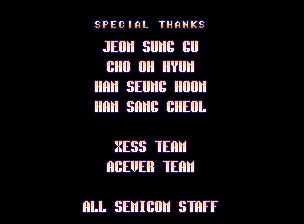
Rolling Crush is the key. The game is an EXIT production, yet its end credits separately thank XESS Team and AceVer Team. That proves those labels could coexist inside the same SEMiCOM production environment rather than representing a simple chain of unrelated companies or clean sequential renames. [S4]
The preservation story behind Rolling Crush is itself worthy of a sidebar on Arcade Side B.
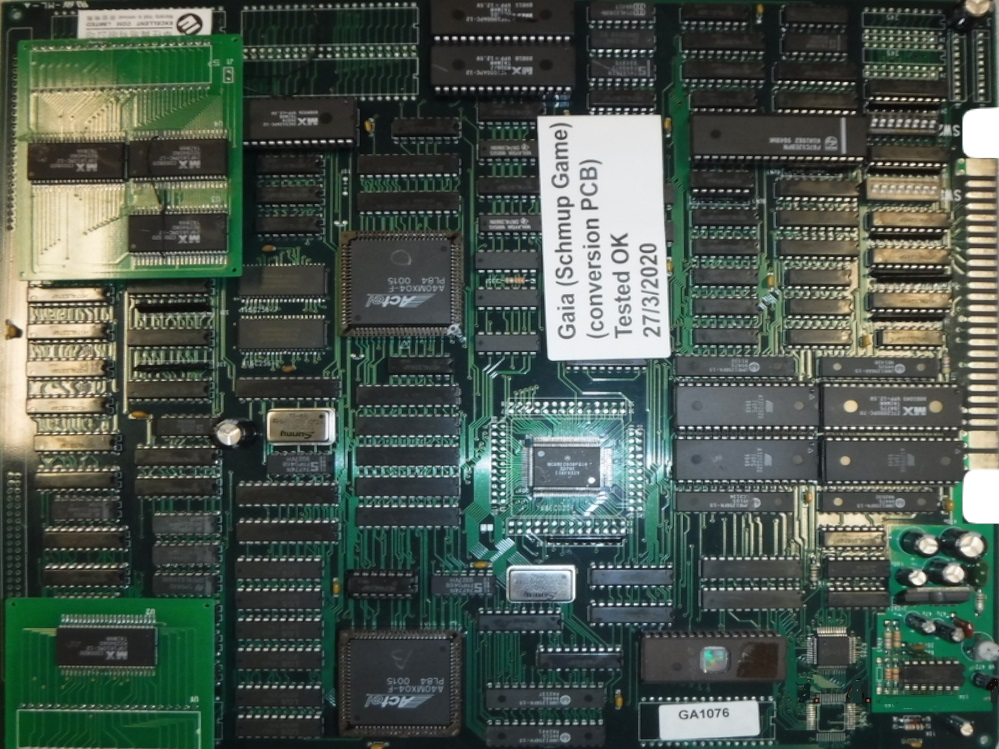
When an original board was acquired and dumped, it did not prominently advertise SEMiCOM. The PCB, however, used an MC68EC020 and AT89C52 MCU configuration that immediately resembled SEMiCOM hardware. The board proved essentially identical to the one used by Dream World, with some sound-chip population differences that placed it near Baryon as well. ROM inspection revealed SEMiCOM-related strings and familiar graphic material. The MCU supplied startup protection data, so preservation work required extracting the needed data from original hardware. Only after the game was completed did the credits briefly expose the actual SEMiCOM copyright.
In other words, attribution came from a chain of evidence: PCB architecture, ROM contents, protection behavior, recurring visual material, staff credits, and the hidden copyright. [S3]
That is Arcade Side B's research philosophy in miniature.
2000: the final 68EC020-era conventional games
Two strict conventional titles sit in 2000:
- Date Quiz Go Go Episode 2
- Dream World
Dream World is the released endpoint of another catalog trap. A title called Lode Quest has circulated in historical lists as though it were a separate released SEMiCOM game. Preservation evidence instead supports treating Lode Quest as an unreleased prototype or development version of Dream World. It is therefore not counted as a 39th game.
The Dream World credits also help extend the personnel map into the new decade. Jeon Jae-yeon appears as director. Chung Il Bong remains in programming, joined by Cheol Soo Kim and Hyun Ho Kim. Kyung Hee Kim and Won Young Lee are credited in character design; Sook Nam Lee appears in map/title work and boss design; Suk Ki Jeon is tied to sound/music.
The spelling changes are mostly the result of Romanization and English name order. Arcade Side B should avoid creating phantom employees simply because "Jeon Seok Gi," "Jeon Seok Gee," and "Suk Ki Jeon" are rendered differently across credits and databases. Where identity is well supported, the publication should show source variants together.
2001: the end of the conventional arcade line
The strict conventional catalog currently ends with four 2001 releases:
- Diet Family
- Wivern / Wyvern Wings
- Mr. Kicker
- Toy Land Adventure
This endpoint corrects a persistent secondary-source problem. Older English histories sometimes date Mr. Kicker to 2003. Current MAME source, however, groups Mr. Kicker with SEMiCOM's 2001 titles and assigns it ©2001. Arcade Side B therefore treats 2001 as the baseline year unless stronger period release evidence proves a later distinct market event. [S6]
Wyvern Wings is one of SEMiCOM's most visible late games and one of its clearer attempts to reach markets outside Korea. Later Japanese and North American appearances should be treated as distribution events, not evidence that the game itself was first developed in those later years. GameVision licensing helped carry it abroad.
An undumped product called Red Wyvern appeared around the same period. Current MAME source still describes it with a question: "A semi-sequel or update?" That uncertainty is preserved. Counting it automatically as another unique conventional release would make the total larger but the history weaker. [S6]
So the strict count remains 38.
The 38-game strict conventional census
The following is Arcade Side B's controlled count of named, distinct, released SEMiCOM-developed conventional arcade products.
1994 — 1
- Magic Ball Fighting
1995 — 5
- Wonder League Star: Sok-Magicball Fighting
- Choky! Choky!
- Hatch Catch
- Cookie & Bibi
- Hyper Pacman
1996 — 6
- Carket Ball
- Cookie & Bibi 2
- Wonder League '96
- Toppy & Rappy
- SD Fighters
- Sutjaro Haeyo Deluxe
1997 — 8
- MuHanSeungBu
- B.C. Story
- Twinkle
- Cookie & Bibi 3
- Puzzle Break
- Baryon: Future Assault
- Wonder Dunk
- Jumping Pams
1998 — 5
- New HyperMan / XESS 3-in-1
- Date Quiz Go Go
- Cute Fighter
- R&B: Rety & Bluemi
- Twinkle II
1999 — 7
- Gaia — The Last Choice of Earth
- Puzzle Express More More
- Puzzle Express More More Plus
- Rolling Crush
- Macheonlu
- Cool Minigame Collection
- 2002 Goal! Goal! Goal!
2000 — 2
- Date Quiz Go Go Episode 2
- Dream World
2001 — 4
- Diet Family
- Wivern / Wyvern Wings
- Mr. Kicker
- Toy Land Adventure
Total: 38
What the number does not include
The number 38 is intentionally conservative and definition-driven. It excludes:
- Final Tetris, Metal Saver, and other predecessor-lineage products released under Cheil Computer System or First Amusement.
- Gambling, medal, poker, slot, and similar products.
- Prototypes and unreleased development versions such as Lode Quest.
- Export renames or presentations that are not distinct underlying games, such as Arirang when treated as a reworked/export presentation of Macheonlu.
- Third-party or bootleg compilations.
- Red Wyvern until evidence establishes whether it is a distinct game rather than an update or semi-sequel.
This means a broader "SEMiCOM-associated arcade artifact" count can be larger than 38 without contradicting the strict conventional total.
The internal teams
SEMiCOM's surviving games use several team names:
- Tirano
- DMD
- XESS
- AceVer
- EXIT
Later Korean histories sometimes describe these with numbered-team labels and implied succession. Some of that may be correct, but Arcade Side B should distinguish what is directly supported from what is inferred.
Directly supported:
Tirano appears on SD Fighters and several 1997 titles.
DMD appears with MuHanSeungBu and the gambling title Gwasuwon.
XESS appears with the New HyperMan material and Gaia. Credits and company attribution make XESS best understood as an internal SEMiCOM development identity.
AceVer appears with Date Quiz Go Go and Macheonlu.
EXIT appears with More More, More More Plus, and Rolling Crush.
Most importantly, Rolling Crush credits thank XESS Team and AceVer Team even though the game itself is associated with EXIT. This directly proves contemporaneous team identities inside the same broader SEMiCOM environment. [S4]
Still unproven:
- DMD formally becoming XESS.
- Tirano formally becoming AceVer.
- Every numbered-team scheme reproduced by later Korean sources.
Those may eventually be supported by staff overlap or a primary company page, but they should remain hypotheses until then.
What the numbered teams probably mean
The internal-team question can now be stated more precisely.
During preservation work on Gaia, MAME developer David Haywood reconstructed a likely late-period numbering scheme from visible team identities:
- 1st Team — EXIT
- 2nd Team — XESS
- 3rd Team — AceVer
But he also pointed out the complication that makes a simple chart misleading: MuHanSeungBu associates DMD with the second-team position, while multiple earlier games associate Tirano with the third-team position. His own conclusion was tentative—perhaps the teams changed names. [S26]
That reconstruction fits the broader SEMiCOM evidence unusually well:
- DMD appears before XESS in the surviving chronology.
- Tirano appears before AceVer.
- EXIT remains the clearest first-team label.
- Rolling Crush later proves that EXIT, XESS, and AceVer could coexist, because its credits thank XESS Team and AceVer Team while the game itself is associated with EXIT.
The strongest current model is therefore team-name succession within numbered development groups, not a chain of separate companies:
- 1st: EXIT
- 2nd: DMD → possibly renamed XESS
- 3rd: Tirano → possibly renamed AceVer
The arrows must remain dotted, not solid. No recovered SEMiCOM memo, organization chart, employment record, or first-party statement has yet proven those renames formally.
This is a useful distinction for Arcade Side B because it lets the page explain the pattern without laundering a preservation hypothesis into corporate fact.
The people behind the labels
Arcade history often reduces small developers to company names because individual credits are difficult to recover. SEMiCOM is unusually rewarding once the credit rolls are compared.
Jeon Jae-yeon (전재연) is the strongest executive anchor. He appears in period trade reporting as SEMiCOM's representative and in game credits as executive producer or director. The current NICE-derived company listing also gives Jeon Jae-yeon as the representative of a business named 세미콤, strengthening—but not formally proving—the continuity between the arcade company and the later software business. [S1][S7]
Chung Il Bong is one of the clearest recurring technical staff members, appearing in design/programming work across B.C. Story, Rolling Crush, Cool Minigame Collection, and Dream World.
Jeon Seok Gee / Jeon Seok Gi / Suk Ki Jeon appears under differing Romanizations and name order in design, programming, music, or sound roles across multiple titles.
Han Seung Hoon appears in design and illustration and later in special thanks, linking the mid-1990s art/design side to later projects.
Kim Hyun Ho / Hyun Ho Kim appears in programming in the XESS era and Dream World.
Kim Kyung Hee, Lee Won Young, and Lee Suk Nam / Sook Nam Lee recur in graphics, character design, map/title design, or boss artwork.
Shin Bong Gu / Shin Bong Koo appears in sound/effects work.
Hardware credits around the B.C. Story and XESS-era material include Jee Deok Kyu, Park Hoon Yong, and Kim In Seok, with Kim Myung Seok also appearing on B.C. Story.
This continuity matters because it turns the company from a succession of mysterious logos into a visible studio. The team names changed; many of the people did not.
Hardware: from derivative platforms to a recognizable SEMiCOM architecture
SEMiCOM's catalog crossed several hardware families.
Some early titles sit within the broad ecosystem of Korean boards derived from or related to familiar late-1980s and early-1990s architectures. Preservation work groups several First Amusement, Mijin, and SEMiCOM titles together because of their technical relationships.
By the Baryon period, SEMiCOM was using a more ambitious 68EC020-based design lineage. Later games such as Cute Fighter, Rolling Crush, and Dream World continued with related 68020-family boards and protection MCUs.
That technical continuity is not merely a modern inference. It lines up directly with the December 1998 Electronic Times description of SEMiCOM as one of the very small group of Korean firms able to design and commercialize its own 2-D boards. [S2]
Two preservation cases are particularly valuable.
Rolling Crush: identifying a manufacturer through hardware
The Rolling Crush board lacked an obvious SEMiCOM identity in the material first available to preservationists. Its MC68EC020 and AT89C52 MCU configuration, however, immediately resembled SEMiCOM hardware. Comparison showed that the PCB was essentially the same design as Dream World, while some details placed it closer to Baryon. ROM inspection exposed familiar SEMiCOM-related material. Protection data had to be extracted from the original hardware. Finally, completing the game produced a credit roll containing the SEMiCOM copyright and familiar staff names. [S3]
Cute Fighter: hardware settles an identity dispute
Older lists often described Cute Fighter as a world release of SD Fighters. Physical evidence contradicted that. The games use different generations of SEMiCOM hardware, and Cute Fighter contains expanded content. Preservation work concluded that it was intended as a sequel rather than a mere alternate-market version. [S5]
These are excellent Arcade Side B examples because they show how physical preservation can correct written game lists.
Gambling, medal, poker, and slot products
SEMiCOM's conventional catalog is only part of its arcade business.
The company also developed gambling, medal, card, poker, and slot-oriented products. These are tracked separately because combining them with the conventional game list creates misleading totals and muddles two different parts of the business.
Current high-confidence side-catalog items include:
- Suhoseong (1997) — card/gambling product.
- Gwasuwon (1997) — Hanafuda/video-slot/medal product associated with SEMiCOM/DMD.
- Final Godori (2001) — Hanafuda/medal product represented in current MAME.
- Choice III: Joker's Dream (2001) — screenshot-supported SEMiCOM medal game; current MAME notes it among undumped SEMiCOM hardware-family products.
- Final Dream 2 (2002) — directly documented as ©2002 SEMiCOM and classified by Arcade-History as a mechanical slot machine. [S8]
Later historical sources also name Final Daebak Deluxe Medal, All Face Poker, and Final Dream, although their exact dates and surviving physical evidence remain less secure in the current project.
This side business is important for interpreting SEMiCOM's end. The conventional videogame line appears to stop in 2001, but SEMiCOM-related arcade-market activity did not necessarily vanish at the same moment. Gambling products, overseas licensing, and other software activity continued.
Export, licensing, and the international footprint
SEMiCOM was primarily a Korean developer, but several products escaped the domestic market.
Wyvern Wings is the clearest late example. It received overseas distribution and later GameVision licensing. That later international circulation has contributed to confused release dates in secondary sources; Arcade Side B separates original copyright/development chronology from later market introductions.
Rolling Crush also demonstrates the importance of distribution labels. The preserved set includes Trust licensing, while SEMiCOM's own identity is hidden deep enough that it was not obvious from the exterior presentation. That does not make Trust the developer.
The broader lesson is that "manufacturer," "developer," "publisher," "licensee," and "distributor" cannot be collapsed into one field when reconstructing small Asian arcade companies. SEMiCOM's history contains too many examples where a board or title reached the market under another label.
A first-party address bridge across the arcade and software eras
The strongest continuity evidence is no longer merely a later company directory repeating an old address.
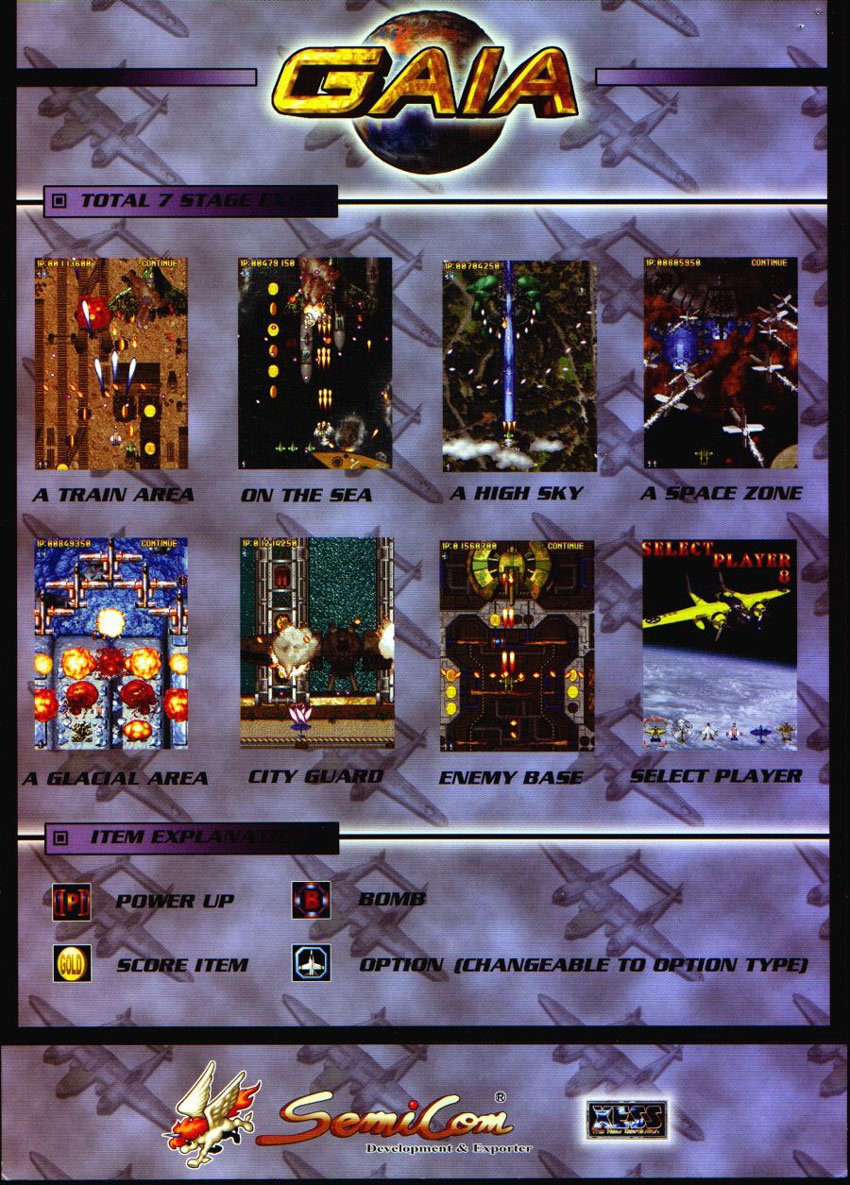
SEMiCOM's own Gaia — The Last Choice of Earth sales flyer prints the arcade-era company address in English as:
SHIN-HAN B/D, 7F, 3-4, CHANG-4DONG, SEOUL, KOREA
The same flyer identifies SEMiCOM as developer/exporter. That makes the location evidence first-party and contemporary to the arcade business rather than a later historical reconstruction. [S23]
The current Saramin/NICE-derived listing for 세미콤 names Jeon Jae-yeon (전재연) as representative and gives the address 서울 도봉구 마들로11길 71, 7층. Korean road-address mapping converts that road address to the parcel 서울특별시 도봉구 창동 3-4. Independent current premises listings at the same road address identify the building as 신한빌딩 / Shinhan Building. [S7][S24]
So the evidence now aligns across:
- company name: SEMiCOM / 세미콤;
- representative: Jeon Jae-yeon in the arcade-era trade press and the current company listing;
- parcel: Chang-dong 3-4;
- building: Shin-Han / Shinhan Building;
- floor: seventh floor.
That is unusually strong continuity evidence for a small arcade developer whose formal corporate papers have not yet been recovered.
It is still not the same thing as a legal registry chain. The project has not located the Jeon Jae-yeon SEMiCOM business-registration number or a registry extract proving uninterrupted legal identity across the entire period. Arcade Side B should therefore avoid the absolute formulation "the exact same legal entity is proven."
A better formulation is:
First-party arcade-era material and current company data independently place SEMiCOM under Jeon Jae-yeon's name at the same Chang-dong 3-4 / Shinhan Building seventh-floor location. The continuity case is therefore very strong, although the formal registration-number chain remains unrecovered.
That wording reflects the evidence without understating it.
A necessary name disambiguation
Korean business searches also surface an unrelated corporation named (주)세미콤 / SEMICOM. That company is associated with representative Jo Han-taek, was established in 1999, operates in medical/electronic or semiconductor-related manufacturing, and is based in Hwaseong rather than Seoul. Public business databases expose a registration number for that unrelated company. [S25]
It must never be merged into the arcade-company record.
The Arcade Side B project controls the target business by the combination of Jeon Jae-yeon + game/software activity + Dobong-gu/Chang-dong address + semicom.com lineage. Any company record lacking those anchors should be treated as a namesake until proven otherwise.
What happened after arcade games?
The safest current statement is that SEMiCOM's conventional arcade videogame development appears to end in 2001, while other activity continued.
Older historical accounts sometimes describe a simple sequence: SEMiCOM made arcade games, quit around 2001–2003, and then moved into business software. That may be directionally true, but the timing is less tidy than it looks.
A current Korean historical compilation claims that SEMiCOM's "Jarin'gobi" office/business software existed alongside its game activity from very early in the company's history. The project has not yet recovered period primary evidence proving that the software line began at or near the company's founding. What is directly demonstrable is that SEMiCOM's own domain was providing version-specific support for Jarin'gobi business software by 2007.
So Arcade Side B should not say that business software definitely began only after arcade games, nor should it state as proven that Jarin'gobi existed from day one. The start date remains open.
The present-day continuity evidence is nevertheless unusually strong.
A current Saramin record sourced to NICE lists a company named 세미콤, representative 전재연, engaged in game-software development, at 서울 도봉구 마들로11길 71, 7층. Historical material places arcade-era SEMiCOM at the corresponding Chang-dong parcel/building and seventh floor. Combined with the same company name and representative, that makes continued business identity highly plausible. [S7]
What is still missing is the clean legal bridge: a recovered business-registration or corporate-registration chain proving uninterrupted identity from the arcade-era company to the current listing.
Until that surfaces, Arcade Side B should use language such as:
The balance of evidence strongly indicates that the present SEMiCOM business continues the company that produced the arcade games, although a formal registry chain has not yet been recovered.
That is strong enough to tell the story without pretending the paperwork has been found.
Preservation correction: semiquiz was a placeholder, not another game
Earlier project checkpoints treated MAME's old Unknown SemiCom Quiz (semiquiz) entry as an unidentified 1998 SEMiCOM product that might represent an additional commercial game outside the strict 38. The release history now shows that interpretation was wrong.
MAME 0.111u3, released January 10, 2007, added Unknown SemiCom Quiz as a new game marked not working. The preserved database entry contains no dump and no historical game information. Eight days later, MAME 0.111u4 added or promoted Date Quiz Go Go (Korea) to working support. Current preservation history explicitly lists semiquiz as the previous romset for dquizgo. [S19][S20]
That sequence is best understood as identification, not discovery of two different games:
- an unidentified SEMiCOM quiz target entered MAME provisionally as
semiquiz; - the game was identified and supported as Date Quiz Go Go;
- the provisional name was superseded.
Arcade Side B should therefore remove semiquiz from the unresolved-product universe. It is historically useful as a preservation anecdote—an example of how an unknown board can acquire its real identity—but it is not evidence of a separate 39th SEMiCOM conventional release.
This correction also illustrates why historical emulator metadata needs to be read chronologically. A database can preserve old shortnames and transition records long after the underlying identification question has been settled. Counting every historical romset label as a commercial product would inflate the catalog.
The strict conventional total remains 38, but one of the former count-sensitive uncertainties is now closed rather than merely excluded.
The Jarin'gobi question: two secondary histories, one verified later business
The post-arcade story still contains one important unresolved timing question: when did SEMiCOM become involved with the Jarin'gobi/CNM business-management software line?
Two later histories tell different stories.
Hardcore Gaming 101's Korean-game history says that around the period when SEMiCOM stopped normal videogame development and concentrated on gambling machines, the company took over distribution and support for Jarin'gobi's CNM office-management series. That account cites an archived SEMiCOM website snapshot from March 31, 2001. [S21]
A newer Korean historical compilation makes a much stronger claim: that SEMiCOM was already making or handling Jarin'gobi business software from the company's early years, in parallel with arcade development.
The project has not recovered enough primary-period documentation to choose between those two narratives.
What can be demonstrated directly is later continuity. SEMiCOM's own domain preserves a 2007 support-board response dealing with Jarin'gobi software version 4.12.01, printer behavior, data entry, backup settings, and reinstall procedures. That is first-party evidence that the SEMiCOM web/domain infrastructure was actively supporting the business-software product line by 2007. [S22]
The safest Arcade Side B chronology is therefore:
- arcade development is securely documented through 2001;
- SEMiCOM was demonstrably associated with Jarin'gobi/CNM support by the early-to-mid 2000s, and definitely on its own domain by 2007;
- one secondary source places the takeover/distribution transition around 2001;
- another claims business-software activity existed much earlier;
- the exact start date remains open.
This is not a trivial wording issue. If the earlier claim is eventually proven, SEMiCOM was a diversified software company that happened to run an arcade-development operation. If the later-transition model is correct, Jarin'gobi was part of a deliberate exit from videogames. Those are meaningfully different company histories.
Until primary evidence settles it, the website should preserve that distinction rather than choosing whichever version makes the cleaner narrative.
Red Wyvern: an uncertainty that has reached diminishing returns
A targeted final search did not produce a flyer, PCB photograph, registration record, screenshot with decisive version information, or first-party SEMiCOM description for Red Wyvern.
Current MAME source still lists it only among undumped SEMiCOM games on similar hardware and asks whether it was "a semi-sequel or update." Hardcore Gaming 101 independently reports that SEMiCOM introduced a machine called Red Wyvern soon after Wyvern Wings, but likewise could not determine whether it was an update or a full sequel. [S6][S27]
That is enough to preserve the name as a real reported SEMiCOM product, but not enough to decide its unique-game status.
Arcade Side B should therefore stop treating Red Wyvern as a problem that must be solved before publication. The correct historical statement is simply:
Red Wyvern was a reported late SEMiCOM machine related to Wyvern Wings. Surviving preservation sources do not yet establish whether it was a distinct sequel or an update, and no dump is currently available.
Unless a new primary artifact surfaces, further repetition of the same two secondary/preservation sources is unlikely to improve the answer.
Open questions
A good company profile should make clear where the record stops.
1. What was the exact legal relationship among Cheil Computer System, First Amusement, Mijin Computer, and SEMiCOM?
The personnel and development lineage is strong. A simple legal rename chain is not yet proven.
2. Can SEMiCOM's formal business-registration history be recovered?
Current commercial company data appears to be keyed to a business-registration number, but the public-facing listing does not expose that number.
3. When did the Jarin'gobi business-software line actually begin?
Later historical sources claim it existed from the early company period. First-party online evidence proves later support activity, not the founding date.
4. Is Red Wyvern a separate game?
It is a real enough reported SEMiCOM product to preserve, but current MAME documentation still asks whether it was a semi-sequel or update.
5. How should the XESS 3-in-1 package be dated?
It carries 1997 copyright/build evidence while current preservation metadata generally places it in 1998.
6. Were DMD→XESS and Tirano→AceVer formal team renames?
The pattern is plausible. Direct internal documentation is still missing.
Catalog notes for the website
The strict census is useful as a control, but a website reader needs more than a title list. These short notes identify what each release contributes to the SEMiCOM story. They are deliberately not reviews and do not attempt to rank the games. Where the surviving evidence is thin, the note says so rather than filling the gap with speculation.
1994
Magic Ball Fighting
The first game in Arcade Side B's strict SEMiCOM count is also one of the clearest bridges back to the First Amusement period. It is a baseball-themed sports game, but historically its greatest value is inside the data: current MAME source preserves unused Metal Saver graphics carrying a 1994 First Amusement copyright. That makes Magic Ball Fighting a rare case where a development transition is visible in the software itself. It should be illustrated with a title/gameplay screen if possible, while the Metal Saver remnant belongs in the evidence discussion rather than being treated as proof of a legal corporate rename. [S28]
1995
Wonder League Star: Sok-Magicball Fighting
A second baseball game and the first major Mijin complication. The game presents ©1995 Mijin Computer, yet current preservation material places it in the SEMiCOM development lineage and SEMiCOM's own indexed historical works material includes it. Current MAME-derived documentation also explicitly says SEMiCOM used the Mijin name in the licensing process through 1995. Arcade Side B therefore counts the development work while keeping the legal Mijin relationship open. It begins a recognizable baseball series that continues through Wonder League '96 and MuHanSeungBu. [S28]
Choky! Choky!
A 1995 SEMiCOM release whose date is worth controlling carefully because older secondary chronologies often place it in 1994. Current MAME source and ROM-derived preservation evidence support ©1995. For the website, its main value is as part of the burst of 1995 output that shows SEMiCOM moving beyond a single sports line into a broader arcade portfolio. [S28]
Hatch Catch
A color-matching puzzle game released in Korea in June 1995. The player shoots colored blocks upward; lines of three or more matching colors disappear, and clearing the field completes the stage. Its credits are historically useful: Jeon Jae-yeon is executive producer, Han Seung Hoon handles game design, Baek Seung Ki is main programmer, Kim Jin Woo assists programming, Jeon Seok Gee handles music/sound effects, and Kim Eun Ae, Hong Young Joo, and Whang O-Sik are credited in graphics. Like Cookie & Bibi, it shows Mijin presentation over a directly credited SEMiCOM development team. [S10][S28]
Cookie & Bibi
The first of SEMiCOM's three Cookie & Bibi games is a bubble-shooter puzzle game strongly modeled on Puzzle Bobble. Its surviving credits again expose the studio behind the company label: Jeon Jae-yeon as executive producer, Baek Seung Ki in programming, Kim Eu Nae in graphics, and Jeon Seok Gee in sound. The series then returns in both 1996 and 1997, making it one of the company's clearest annualized product lines. [S11][S28]
Hyper Pacman
One of SEMiCOM's best-known games outside Korea and one of the easiest examples of the company's habit of taking a familiar arcade idea and expanding it aggressively. The 1995 game adds jumping, secret items, power-ups, bosses every ten stages, and a two-player mode to a Pac-Man-derived maze structure. Preservation records date the Korean release to September 1995 and retain a substantial staff list headed by Jeon Jae-yeon, designer Han Seung Hoon, programmers Kim Hyun Ho and Kim Jin Woo, artist Hong Young Joo, and sound staff Oh Gyeong Hun and Jeon Seok Gee. It later feeds directly into the Twinkle line. [S9]
1996
Carket Ball
A two-player hybrid built around billiards and cards. Current MAME-derived technical records show a 68000/Z80 board and unusually specific operator settings for default cards and balls. The game matters less for celebrity than for range: by 1996 SEMiCOM could move from baseball and bubble puzzles to a strange cue-sport/card mixture without abandoning its existing series. [S30]
Cookie & Bibi 2
The second annual Cookie & Bibi entry keeps the company's Puzzle Bobble-style line alive. Its importance to the company story is the repetition itself: SEMiCOM was now maintaining recognizable sequel families rather than releasing only isolated experiments. [S30]
Wonder League '96
The third product in the baseball sequence that begins with Magic Ball Fighting and Wonder League Star. Its place in the series helps demonstrate that sports games were a sustained business line rather than a one-game experiment. The following year's MuHanSeungBu completes the four-title run preserved in current history databases. [S28]
Toppy & Rappy
A two-player action game on 68000/Z80 hardware. Later Korean-history work describes it as a spiritual successor to Metal Saver, with two protagonists who buy weapons and ammunition using money earned during play. Even without treating that comparison as a formal series relationship, the game is useful evidence that personnel and design interests from the predecessor era continued inside SEMiCOM. [S21]
SD Fighters
A Korean one-on-one fighting game with eight super-deformed characters and three-button controls. More important historically, the ROM-derived record explicitly identifies it as a product of SEMiCOM's Tirano (3rd) team. It is therefore one of the best early anchors for the internal-team structure that becomes much more visible in 1997–99. [S28][S26]
Sutjaro Haeyo Deluxe
An obscure 1996 release whose preservation history is almost more important than its gameplay. A dumped set only entered modern MAME preservation in the 2024 period. It is a good Arcade Side B reminder that absence from long-standing emulator lists does not equal nonexistence; obscure Korean boards can surface decades after the commercial life of the company. [S30]
1997
MuHanSeungBu
A June 1997 Korean baseball game and the fourth known entry in the sequence that began with Magic Ball Fighting. Preservation records place it under SEMiCOM/DMD. That combination makes it valuable twice over: it closes a sustained sports series and gives DMD a concrete conventional-game anchor. [S12][S28]
B.C. Story
A prehistoric mini-game collection in the broad Track & Field tradition, built around a set of exaggerated stone-age events. Historically it is one of the most useful SEMiCOM games because its credit roll exposes a large production team across design, programming, illustration, graphics, sound, and hardware. The credits make it possible to track people such as Chung Il Bong, Jeon Seok Gee, Han Seung Hoon, Kim Kyung Hee, Cho Oh Hyun, Shin Bong Gu, Jee Deok Kyu, Park Hoon Yong, and Kim In Seok into later projects. [S29]
Twinkle
The direct successor line to Hyper Pacman, but with SEMiCOM's own title rather than the borrowed Pac-Man name. Later Korean-history material describes it as a return to the maze formula with new mazes and power-ups, and current preservation metadata associates it with Tirano. On the site, Hyper Pacman and Twinkle work well as a paired example of SEMiCOM gradually turning an openly derivative idea into its own continuing product line. [S21]
Cookie & Bibi 3
The third annual Cookie & Bibi release closes the 1995–97 bubble-puzzle trilogy. The trilogy is useful evidence of SEMiCOM's commercial rhythm: repeated yearly updates sat alongside riskier one-off experiments. [S30]
Puzzle Break
A 1997 SEMiCOM/Tirano puzzle game on the familiar 68000/Z80 family. Later descriptions compare its play to Arkanoid or Breakout-style games because of its upgrade and weapon systems. Its direct Tirano attribution helps fill out the 1997 team map beyond B.C. Story and Baryon. [S21]
Baryon: Future Assault
A vertical shooter based on Acro Studio's 1995 Korean PC game Baryon, but changed substantially enough that later Korean-history work treats the arcade version as effectively a new game rather than a straight conversion. Current hardware records identify SEMiCOM/Tirano and a Motorola 68EC020 plus Atmel MCU. That makes Baryon a key turning point in both software ambition and board architecture. [S3][S21]
Wonder Dunk
A 1997 basketball title preserved more strongly in Korean catalog and company-linked historical material than in mainstream Western game lists. It belongs on the website partly because of that preservation imbalance: it is a real SEMiCOM release that would be easy to lose in an emulator-only history. Period advertising should be prioritized as its lead image. [S21]
Jumping Pams
A 1997 SEMiCOM action game known from screenshots and historical records even though it remains obscure. Arcade-History preserves ©1997 SEMiCOM from screenshots, while Korean-history material describes it as a single-screen labyrinth game. It is a good candidate for a compact "survives in screenshots" presentation rather than pretending we know more than the evidence shows. [S21]
1998
New HyperMan / XESS 3-in-1
A three-game package combining Cookie & Bibi, a renamed Hyper Man, and New Hyper Man. It is a critical XESS anchor but carries a genuine chronology problem: ROM/screenshot-derived material records ©1997 SEMiCOM, while current MAME metadata files it under 1998. Arcade Side B should preserve both facts. The package is more valuable historically than aesthetically because it helps establish XESS as a SEMiCOM development identity. [S21][S26]
Date Quiz Go Go
A two-player quiz game associated with SEMiCOM/AceVer. Current preservation shows a 68000/Z80/AT89C52 configuration and a direct sequel in 2000. Its value in the company narrative is that AceVer is not just a name attached to Macheonlu; it is already present in the 1998 catalog. [S20][S28]
Cute Fighter
A sequel-scale expansion of the earlier SD Fighters concept. Physical-board preservation is especially important here because older lists sometimes reduced it to a world version or update. David Haywood's examination found a later 68020-family board rather than the older 68000-era SD Fighters platform, plus additional characters and different stages. That hardware evidence strongly supports treating it as a distinct game. [S5]
R&B: Rety & Bluemi
A 1998 SEMiCOM puzzle game preserved through screenshot/history evidence rather than a mainstream current MAME set. Later Korean-history work places it close to the Cookie & Bibi formula without making it an official numbered sequel. On Arcade Side B it belongs with the "known from surviving visual evidence" titles rather than being omitted simply because preservation is incomplete. [S21]
Twinkle II
The 1998 sequel to Twinkle, again supported by screenshot-based evidence. Very little firm gameplay documentation survives compared with the first Twinkle, which is precisely why the screenshot provenance should be visible in the page's notes. It completes the known conventional Hyper Pacman/Twinkle lineage without relying on later third-party multicade material. [S21]
1999
Gaia — The Last Choice of Earth
A seven-stage shooter associated with SEMiCOM/XESS. The surviving two-page SEMiCOM sales flyer is one of the strongest visual assets in the entire project: it identifies the company and XESS together, shows the stage progression and selectable craft, and carries the company's contemporary Seoul address. Current technical records place the game on the 68EC020/AT89C52 family. The game is therefore useful simultaneously as a product, hardware, team, and corporate-address artifact. [S17][S23][S26]
Puzzle Express More More
A 1999 mini-game collection containing 17 challenges. ROM-derived history explicitly says it was developed by 1st Team EXIT, making it one of the cleanest team-name anchors. The structure rewards successful completion of short challenges and grants an extra life after multiple excellent ratings. [S13]
Puzzle Express More More Plus
Released in the same year, the sequel expands the collection to 20 mini-games and allows direct selection from the complete set. The surviving two-page flyer is especially valuable because it carries the SEMiCOM identity and explicitly prints 1ST TEAM, EXIT on the rear page. It is one of the few publication assets where marketing art and internal-team evidence appear together. [S13][S17]
Rolling Crush
A 1999 Puzz Loop-style game released in February. Its end credits make it one of the central games in the entire company history: an EXIT production that separately thanks XESS Team and AceVer Team. That one credit screen disproves the idea that these labels were simply a neat sequence of unrelated companies. The board's hidden SEMiCOM identity, protection MCU, and later preservation work also make it the best case study for evidence-based attribution. [S3][S4]
Macheonlu
A March 1999 SEMiCOM/AceVer mini-game product on the earlier 68000/Z80 family. Its operator settings include traditional versus picture tile presentation and configurable mini-game frequency. The game later received the 2002 export presentation Arirang. That export relationship is directly stated in current Arcade-History material, so Arirang should be shown as evidence of later international reuse rather than counted as another unique conventional game. [S14]
Cool Minigame Collection
A remarkably large 1999 collection of 36 mini-games arranged in six pages. It also preserves an extensive late-period staff list: Jeon Jae-yeon as executive producer, Chung Il Bong, Jeon Seok Gi, and Jeon Seong Gu in programming, Shin Bong Koo in sound, and a large graphics team including Lee Suk Nam and Lee Won Young. The Hyperstone E1-16T CPU also shows SEMiCOM moving beyond a single processor family. [S15]
2002 Goal! Goal! Goal!
Despite the title, this belongs to the 1999 conventional census. The "2002" is part of the product name rather than evidence of a 2002 release. Its presence is a useful cautionary example for the website: product titles cannot be treated as dates without independent evidence. [S30]
2000
Date Quiz Go Go Episode 2
The sequel to 1998's Date Quiz Go Go. It shows that the quiz line survived the team's transition into the new decade and reinforces the continuity of products across the internal-label era. [S6]
Dream World
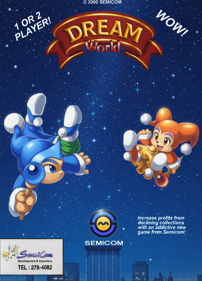
A 2000 platform/action game on the 68EC020 family and one of the best-preserved late SEMiCOM titles. Its credits continue many names seen earlier, including Chung Il Bong, Hyun Ho Kim, Kyung Hee Kim, Won Young Lee, Sook Nam Lee, and Suk Ki Jeon, while Jeon Jae-yeon appears as director. The unreleased Lode Quest is best treated as a prototype/development version of Dream World, not another commercial release. [S3][S6]
2001
Diet Family
A 2001 vertical shooter built around five deliberately unusual selectable characters and a comic premise centered on destroying food and avoiding weight gain. Arcade-History cites both ROM and screenshot evidence and preserves an old official SEMiCOM page URL. It is a useful reminder that SEMiCOM's late conventional output was still willing to be eccentric rather than settling into a single genre. [S16][S6]
Wivern / Wyvern Wings
One of SEMiCOM's most internationally visible late titles. The most useful chronology is layered rather than contradictory: MAME and the title-screen evidence support 2001, the surviving SEMiCOM/GameVision flyer is cataloged as 2001, and Japanese commercial release is documented in February 2002. GameVision later distributed it as Wyvern Wings. The two-page flyer should be one of the site's hero visual assets because it documents both SEMiCOM's product and its overseas licensing path. [S6][S17]
Mr. Kicker
A 2001 maze-action game and another example of a derivative form being reworked substantially. Current descriptions treat it as a Pac-Man variant built around 50 single-screen levels, but the project controls its date from MAME evidence at ©2001 rather than the older 2003 date found in secondary lists. Its dual surviving PCB variants also make it useful in the late-hardware appendix. [S6]
Toy Land Adventure
A 2001 two-player stage-action game with six worlds and 54 stages. Contemporary description text preserved by Arcade-History explains the premise around a corrupted "Mr. Monitor" and the cat-and-dog toy heroes trying to cut his power. The page also preserves an old official SEMiCOM URL, giving the title an unusually direct connection to the company's own web-era catalog.
Editorial conclusion
SEMiCOM's obscurity is deceptive.
Its games rarely appear in standard histories of the 1990s arcade industry, yet the company produced a controlled conventional catalog of 38 released games in only a few years, alongside gambling and medal products. It maintained multiple internal development identities. Staff recur across those labels. The hardware moved from familiar derivative Korean architectures into protected 68020-family designs. Period trade reporting placed the company among the handful of domestic firms capable of designing and commercializing their own 2-D arcade boards. Some of its games reached foreign markets. Some remain poorly preserved. The preservation record still contains unresolved products such as Red Wyvern, but the former semiquiz mystery is now closed as an early placeholder for Date Quiz Go Go.
And unlike many vanished arcade manufacturers, SEMiCOM appears not to have disappeared completely.
The strongest evidence suggests a business bearing the same name, led by the same Jeon Jae-yeon and tied to the same historical location lineage, continued into software after the conventional arcade line ended. The final legal paperwork connecting every stage has not yet surfaced, but the historical continuity is far stronger than the company's near-total absence from English-language arcade history would suggest.
That makes SEMiCOM a natural Arcade Side B subject: not because it produced one universally famous masterpiece, but because the surviving fragments reveal an entire working arcade studio that history almost flattened into a footnote.
Source register
[S1] Electronic Times — "국산 아케이드 게임 입지 확대" — 1998-11-24 Period Korean trade reporting naming SEMiCOM representative Jeon Jae-yeon and describing SEMiCOM as an active sports/puzzle arcade developer. https://www.etnews.com/199811240061
[S2] Electronic Times — "개발업체 현주소.. 업소용 아케이드" — 1998-12-04 Period industry survey placing SEMiCOM among roughly 5–6 Korean firms commercializing self-designed 2-D arcade boards. https://www.etnews.com/199812040118
[S3] David Haywood / Haze — "Semi-Semicom" — 2014-07-17 Physical-board, ROM, MCU/protection and hidden-credit analysis of Rolling Crush; comparative Dream World and Baryon hardware evidence. https://mamedev.emulab.it/haze/2014/07/17/semi-semicom/
[S4] Arcade-History — Rolling Crush ROM/screenshot-derived staff credits; EXIT context and special thanks to XESS Team and AceVer Team. https://www.arcade-history.com/game/32283/rolling-crush
[S5] David Haywood / Haze — "Cute!" — 2014-11-27 Physical-board evidence distinguishing Cute Fighter from SD Fighters, including hardware generation and content differences. https://mamedev.emulab.it/haze/2014/11/27/cute/
[S6] Current MAME source — vamphalf.cpp Current preservation baseline for 2000–2001 SEMiCOM games; ©2001 Mr. Kicker; undumped Red Wyvern note; Choice III note. https://github.com/mamedev/mame/blob/master/src/mame/misc/vamphalf.cpp
[S7] Saramin / NICE-derived current company record — 세미콤 Current company listing naming Jeon Jae-yeon, game-software development, and the Dobong-gu seventh-floor address. https://www.saramin.co.kr/zf_user/company-info/view/csn/dEZuZ1JDcVNEZ2V2NTZQTWpOVzVSQT09/company_nm/%EC%84%B8%EB%AF%B8%EC%BD%A4
[S8] Arcade-History — Final Dream 2 Screenshot-derived record: Final Dream 2 ©2002 SemiCom; mechanical slot-machine classification. https://www.arcade-history.com/?id=112731&n=final-dream-2&page=detail
Additional working sources
- Current MAME/ArcadeItalia SEMiCOM manufacturer listings.
- MAME
tumbleb.cppfor First Amusement/Mijin/SEMiCOM hardware relationships and early-title notes. - Arcade-History title records and ROM-derived credits.
- SEMiCOM's indexed historical works page at semicom.com (live page intermittently returns server errors).
- Hardcore Gaming 101's Korean gaming history as a useful secondary map, checked against stronger primary/preservation evidence.
- Korean historical compilations for leads and untranslated names, never treated as sole authority when stronger evidence conflicts.
[S9] Arcade-History — Hyper Pacman ©1995, September release note, gameplay description, and ROM-derived staff credits. https://www.arcade-history.com/game/1163/hyper-pacman
[S10] ArcadeItalia / MAME-derived history — Hatch Catch June 1995 Korean release, direct SEMiCOM development credit, and staff list under Mijin copyright. https://adb.arcadeitalia.net/dettaglio_mame.php?game_name=htchctch
[S11] Arcade-History — Cookie & Bibi ©1995 Mijin Computer with explicit "Developed by SemiCom" staff credits. https://www.arcade-history.com/?id=3952&n=cookie-and-bibi&page=detail
[S12] Arcade-History — MuHanSeungBu ©1997 SEMiCOM, June 1997 release, and four-game baseball series listing. https://www.arcade-history.com/game/4851/muhanseungbu
[S13] Arcade-History / current preservation — More More and More More Plus ©1999, 17- and 20-mini-game structures, and explicit 1st Team EXIT attribution. https://www.arcade-history.com/game/3911/more-more https://www.arcade-history.com/game/1672/more-more-plus-puzzle-express
[S14] Arcade-History — Macheonlu / Arirang Macheonlu ©1999 SEMiCOM; Arirang ©2002 export version of Ma Cheon Ru. https://www.arcade-history.com/game/94043/ https://www.arcade-history.com/game/21053/arirang
[S15] ArcadeItalia — Cool Minigame Collection ©1999 SEMiCOM, 36 mini-games, Hyperstone E1-16T hardware, and full staff credits. https://adb.arcadeitalia.net/dettaglio_mame.php?game_name=coolmini&lang=en
[S16] Arcade-History — Diet Family and Toy Land Adventure Late 2001 gameplay descriptions and surviving old official SEMiCOM page URLs. https://www.arcade-history.com/?id=4010&n=diet-family&page=detail https://www.arcade-history.com/?id=4009&n=toy-land-adventure&page=detail
[S17] TAFA / International Arcade Museum flyers Verified front/back flyer source pages for Gaia, Puzzle Express More More Plus, Wyvern Wings G7, and Arirang. https://flyers.arcade-museum.com/videogames/show/3799 https://flyers.arcade-museum.com/videogames/show/3121 https://flyers.arcade-museum.com/videogames/show/2124 https://flyers.arcade-museum.com/videogames/show/5618
[S18] 2002 Korea Game White Paper — Korean arcade certification table The 1997 table lists Suhoseong with 7,000 certification/approval issuances. This is a market-distribution indicator, not a direct retail-sales count. Korea Culture & Content Agency / Korean game-industry white paper, page containing the 1997–2001 major-product table.
[S19] MAME 0.111u3 release notes — 2007-01-10 Introduced "Unknown SemiCom Quiz" as a new game marked GAME_NOT_WORKING. https://wiki.mamedev.org/index.php/MAME_0.111u3
[S20] MAME 0.111u4 / Date Quiz Go Go preservation history — 2007-01-18 Promoted Date Quiz Go Go (Korea); current preservation history lists semiquiz as the previous romset for dquizgo. https://wiki.mamedev.org/index.php/MAME_0.111u4 https://adb.arcadeitalia.net/dettaglio_mame.php?game_name=dquizgo
[S21] Hardcore Gaming 101 — SEMiCOM company history Secondary history says SEMiCOM took over distribution/support for Jarin'gobi's CNM office-management series around the end of its conventional arcade period; cites a 2001 archived SEMiCOM site. https://www.hardcoregaming101.net/korea/part2/company-semicom.htm
[S22] SEMiCOM official-domain support board — 2007 First-party support response for Jarin'gobi version 4.12.01 and related operational issues, demonstrating SEMiCOM-domain support of the business-software line by 2007. https://www.semicom.com/comzy/bbs/board.php?bo_table=free&page=17&sfl=&sod=desc&sop=and&sst=wr_hit&stx=&wr_id=245
[S23] SEMiCOM — Gaia sales flyer, front page First-party SEMiCOM sales material giving the arcade-era address as "SHIN-HAN B/D, 7F, 3-4, CHANG-4DONG, SEOUL, KOREA" and identifying SEMiCOM as Development & Exporter. https://flyers.arcade-museum.com/videogame-flyers/3/gaia-the-last-choice-of-the-earth-03794-01.jpg
[S24] Korean road-address / current-building mapping 71 Madeul-ro 11-gil maps to Seoul, Dobong-gu, Chang-dong 3-4; current premises listings at the address identify Shinhan Building. https://jusoga.com/b/1132010700100030004014393/%EC%84%9C%EC%9A%B8%ED%8A%B9%EB%B3%84%EC%8B%9C-%EB%8F%84%EB%B4%89%EA%B5%AC-%EB%A7%88%EB%93%A4%EB%A1%9C11%EA%B8%B8-71-%EC%B0%BD%EB%8F%99
[S25] NICE Biz / Korean business directories — unrelated (주)세미콤 Namesake corporation led by Jo Han-taek, established 1999 in Hwaseong and engaged in medical/electronic manufacturing. This is NOT Jeon Jae-yeon's arcade/software SEMiCOM. https://m.nicebizinfo.com/ep/EP0100M002GE.nice?kiscode=186997
[S26] David Haywood / Haze — "The Last Choice" — 2015-07-09 Preservation reconstruction suggesting 1st Team EXIT, 2nd Team XESS, 3rd Team AceVer, while noting DMD also appears as 2nd and Tirano as 3rd and proposing that the team names may have changed. https://mamedev.emulab.it/haze/2015/07/09/the-last-choice/
[S27] Hardcore Gaming 101 — SEMiCOM late-period history Reports Red Wyvern shortly after Wyvern Wings but explicitly says update versus full sequel is unknown. https://www.hardcoregaming101.net/korea/part2/company-semicom3.htm
[S28] Current MAME source — tumbleb.cpp Current MAME source for the First Amusement / Mijin / SemiCom-related hardware family. It dates Magicball Fighting to 1994; Hatch Catch, Cookie & Bibi, Choky! Choky!, and Wonder League Star to 1995; Wonder League '96 and SD Fighters to 1996; B.C. Story and MuHanSeungBu to 1997; and Date Quiz Go Go to 1998. It also explicitly notes that SEMiCOM used the Mijin name through 1995. https://github.com/mamedev/mame/blob/master/src/mame/dataeast/tumbleb.cpp
[S29] Arcade-History — B.C. Story ROM/screenshot-derived credits preserving the 1997 staff roster across executive production, design, programming, illustration, graphics, sound/effects, and hardware. https://www.arcade-history.com/?id=216&n=b.c.-story&page=detail
[S30] ArcadeItalia / current MAME-derived SEMiCOM catalog records Working preservation reference used for several less-documented SEMiCOM releases and current machine metadata. Individual title records are treated as preservation evidence rather than automatic proof of original commercial chronology. https://adb.arcadeitalia.net/lista_mame.php?arcade_only=0¤t_version=0&escludi_lista_utente=&manufacturer=SemiCom