Overview
Thief arrived in the crowded 1981 maze-chase market with a getaway-car theme, varied street layouts and recorded police-radio dialogue. Its basic relationship to Pac-Man is apparent, while the pursuit setting, criminal ranks and sound give Pacific Novelty’s game a distinct presentation.
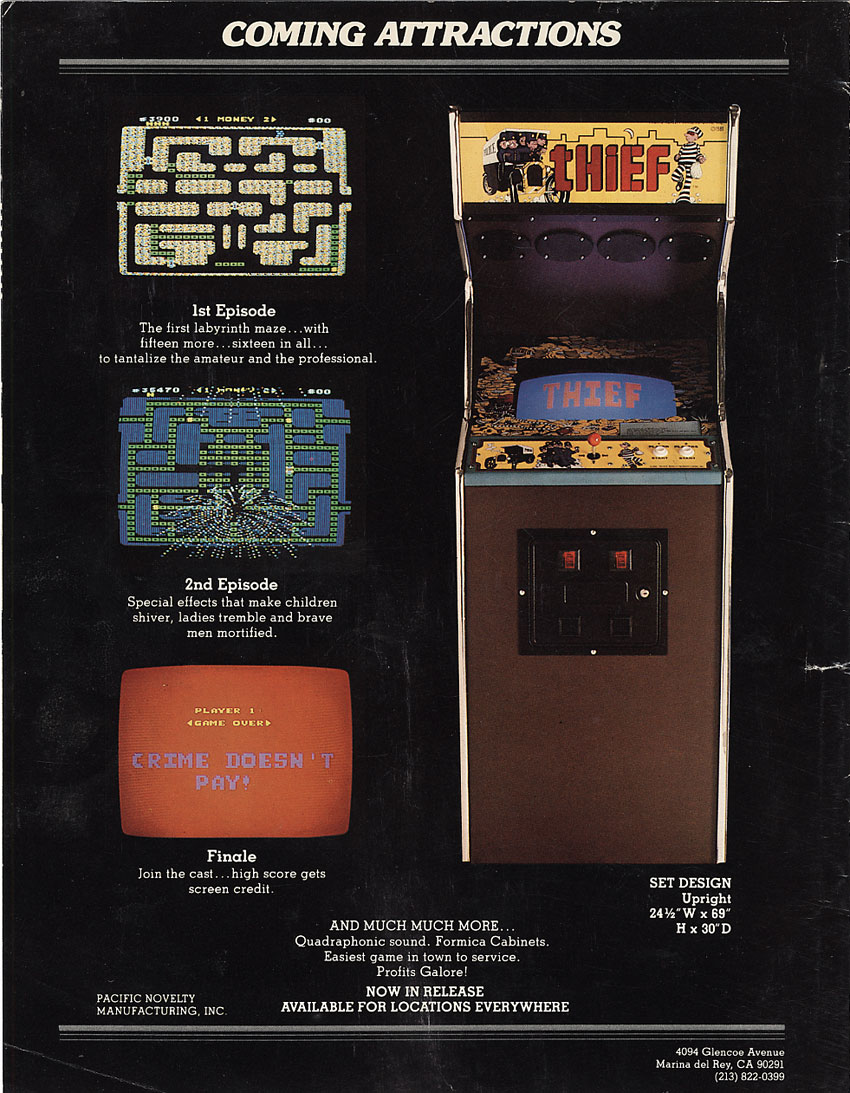
The player drives a getaway car through city streets while police cars converge. Collecting money provides the main objective, and dollar-sign power items allow the car to run police off the road. A criminal-rank ladder, progressing from petty offenses to Public Enemy #1, turns repeated play into an exaggerated criminal career. These elements give the maze-chase rules a consistent setting and a sense of escalation.
How it plays
At the most basic level, Thief asks the player to drive through a maze, collect money and evade police. Ordinary greenbacks are worth 10 points each. Police cars do not just lumber randomly; they converge, cut off routes and force quick directional judgments. Side tunnels can abruptly change an escape line. The dollar-sign power items let the player smash pursuing police cars for escalating point values—100, 500, 1,000 and 2,000 if chained effectively.
Thief uses eight distinct maze layouts, ranging from open escape routes to cramped streets with tight corners and dangerous intersections. After all eight, the sequence repeats at greater speed and with a shorter power phase. Players must learn several street plans while adapting to faster pursuit and reduced opportunities to attack the police. That structure makes the game read almost like a sequence of urban set pieces rather than a single abstract board. A long game is not simply a matter of surviving one repeated pattern forever; it involves memorizing several layouts and then handling them again under greater pressure.
The criminal-rank ladder
One of Thief’s cleverest touches is the mock criminal-career ladder. As the player progresses, the game assigns and upgrades titles ranging from petty misdemeanor humor up through more grandiose outlaw status. Surviving sources preserve ranks such as Loitering, Joyriding, Petty Thief, Car Theft, Grand Theft Auto, Professional Thief, Jewel Thief, The Boss and ultimately Public Enemy #1. The ranks add continuity to successive stages and reinforce the cabinet’s crime-film theme. They also make the player’s progress legible to spectators, who can follow both the chase and the increasingly grandiose criminal status it confers.
Audio and presentation
The cabinet’s cassette mechanism plays an extended loop of police pursuit dialogue. References to streets, locations and progress reports, often with a Los Angeles flavor, connect the moving cars to an ongoing police response. The recordings provide a sustained setting for the action beyond the electronic sounds generated by the game.
Electronic Games treated the audio as the feature that elevated Thief above a crowded maze-chase field. The magazine later revisited the title in awards coverage, giving it a Certificate of Merit and again emphasizing the sound.
This feature was strong enough that it confused contemporary coverage. Electronic Games initially described the voices as coming from an advanced speech-chip solution. Pacific Novelty and industry technicians later corrected the magazine, which printed an explicit correction explaining that the sound was actually provided by a tape-loop system. The correction demonstrates how distinctive the cabinet seemed even to informed contemporary observers.
The cassette system is also important to preservation. A surviving machine with a missing or inoperative audio mechanism retains its game program but loses much of the sound that shaped the original experience.
Movie-style credits
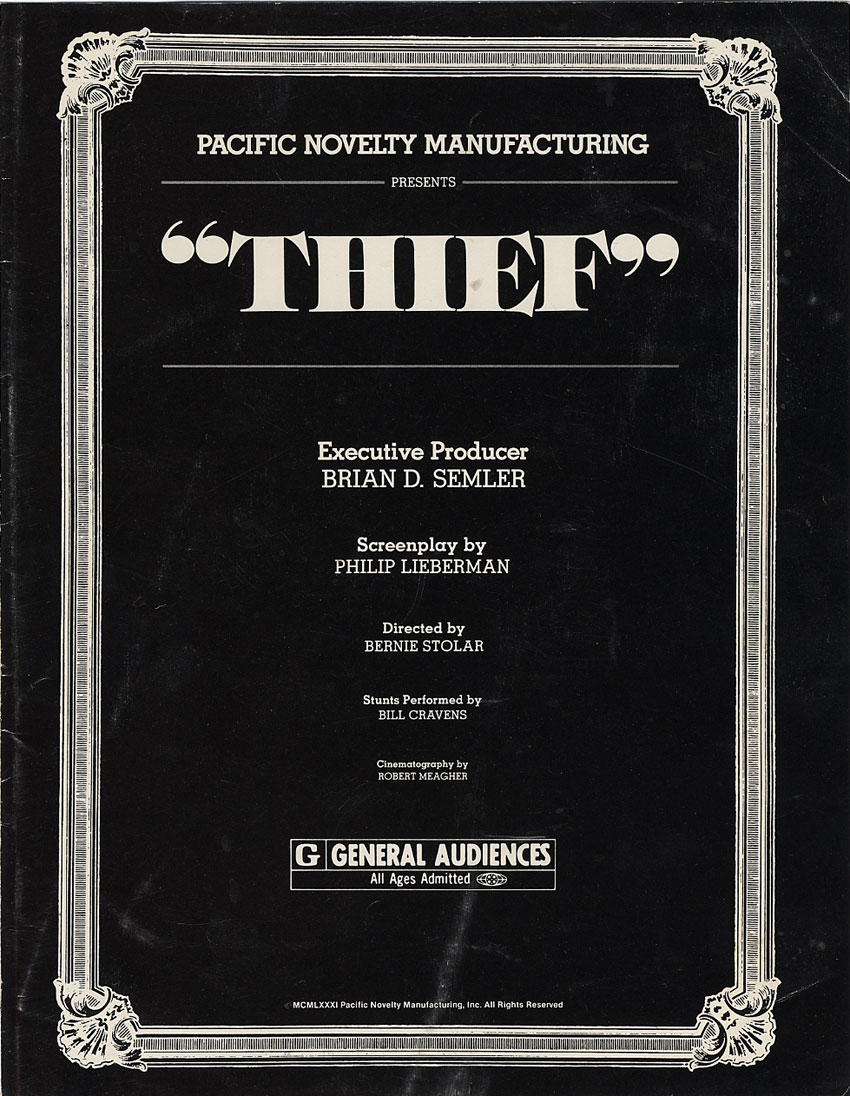
Thief’s in-program credits imitate a film: Philip Lieberman is writer and screenplay author, Brian D. Semler executive producer, Bernie Stolar director, Bill Cravens the provider of “stunts,” and Robert Meagher responsible for cinematography. Their playful presentation preserves named contributions that are rarely so well documented for a small early-1980s arcade company.
The film-credit format complements the company’s use of recorded voices in Shark Attack and police-radio chatter in Thief. In each case, presentation gives the machine a theatrical character beyond its immediate rules.
Commercial position
Thief is Pacific Novelty’s best-known surviving game. More examples are documented than for the company’s other dedicated machines, and later score records attest to continued play. Neither surviving cabinets nor score reports, however, supplies a reliable 1981 factory production total.
National score reporting recorded Brian Wathen of Owensboro, Kentucky at 6,130,930 points in early 1983, demonstrating committed play after the launch period. Classic Arcade Gaming’s later historical reconstruction records Mike Ziara at 9,456,120 points at the Golden Dome Arcade in Salisbury, Maryland on April 25, 1983. Modern VAPS census participation provides a separate record of surviving cabinets. Together with the score history, it supports Thief’s position as Pacific Novelty’s most visible surviving game, while leaving original production and sales totals unresolved.
A period distributor report, sales ledger, operator earnings chart or serial-number study could clarify how Thief’s later visibility compares with its original commercial performance.
Why Thief matters
Thief brings together several features of Pacific Novelty’s work: familiar rules adapted through a distinctive theme, recorded sound as a major part of the cabinet, and unusually informative personnel credits. Its eight mazes and criminal-rank progression give players several forms of continuing challenge. Continuing score records and cabinet preservation also provide a more substantial afterlife than is documented for the company’s other videogames. That record makes Thief a useful introduction to both Pacific Novelty and the later history of its machines.
Contribute
Marquee and cabinet photographs, manuals, operator paperwork, score records, serial numbers and corrections could help document Thief more fully. Contributions with clear provenance are particularly useful, and contributors can be credited with permission.