
Technical Snapshot
- Title: Exzisus (イグジーザス).
- Original publisher: Taito Corporation, Japan.
- Original year: 1987. August 1987 is reported by game catalogs; a dated original launch advertisement has not yet been independently verified.
- Genre: horizontally scrolling science-fiction shooter, with robotic transformation, blaster/missile attacks and animal-robot options.
- Players and controls: one or two players alternating, eight-way joystick and two action buttons. The Japanese instruction card labels A for blaster/missile firing and B for option firing.
- Game identity: Japan dedicated hardware B12, Japan conversion board B23, and TAD-licensed export variant of the B23 family.
- Computing and sound: four Z80 processors, YM2151 synthesis; two TC0010VCU video devices in MAME's documented architecture.
- Display: dedicated B12 board with separate RGB outputs for background and sprites, associated with a two-CRT half-mirror special cabinet; later B23 JAMMA conversion with one combined video output.
- Known game credits in original program: T. Yoshikawa and T. Murata, listed as programmers.
- Modern preservation: MAME's dedicated, conversion and TAD sets; Taito Legends compilation in 2005; Taito Memories II in Japan in 2007; Arcade Archives and Arcade Archives 2 editions on November 5, 2026.
- Version distinction: Arcade Archives and Arcade Archives 2 are modern product lines; B12 and B23 identify historical arcade hardware families.
One picture, two screens
On an ordinary monitor, Exzisus looks like a busy Taito shooter from 1987. A small armed robot flies over strange landscapes, gathers weapons and changes into a jet while mechanical animals and enormous enemies fill the screen. The music keeps the action moving. The surprise is in the original equipment: one version sent its background and foreground pictures to separate television tubes. A partially reflective mirror brought them together in the player's view, with the moving figures appearing at a different depth from the scenery.
An operator could also buy a conventional version for a single-monitor cabinet. It carried the same title and much of the same imagery, but accounts of the two programs describe changes to enemy entrances, defensive equipment and the way upgrades were earned. The special cabinet and the ordinary conversion offered different ways to encounter Exzisus, both on the screen and in the arcade. Following those differences leads from the game itself to its boards, its unusual display and the software later recovered for home players.
Two Taito product codes keep the versions straight. B12 identifies the dedicated form associated with the mirror display; B23 identifies the standard JAMMA conversion. Some later catalogs discuss Exzisus under B23 without explaining the earlier machine, while an emulator's single combined output can conceal the distinction altogether. The original board's separate video connections, MAME's hardware catalog and Japanese recollections of the cabinet agree on the essential point: the two-screen version was real. Its exact internal arrangement is still missing from the surviving documentation.
HAMSTER's November 5, 2026 release brought the question back into view. Japanese reports of its presentation announced both historical versions for the new Arcade Archives edition. Players accustomed to the conversion could now revisit the dedicated program as well. Recovering that program brings back its rules and artwork; reproducing the original depth effect also depends on the display.
A robot in the Fourth Galaxy
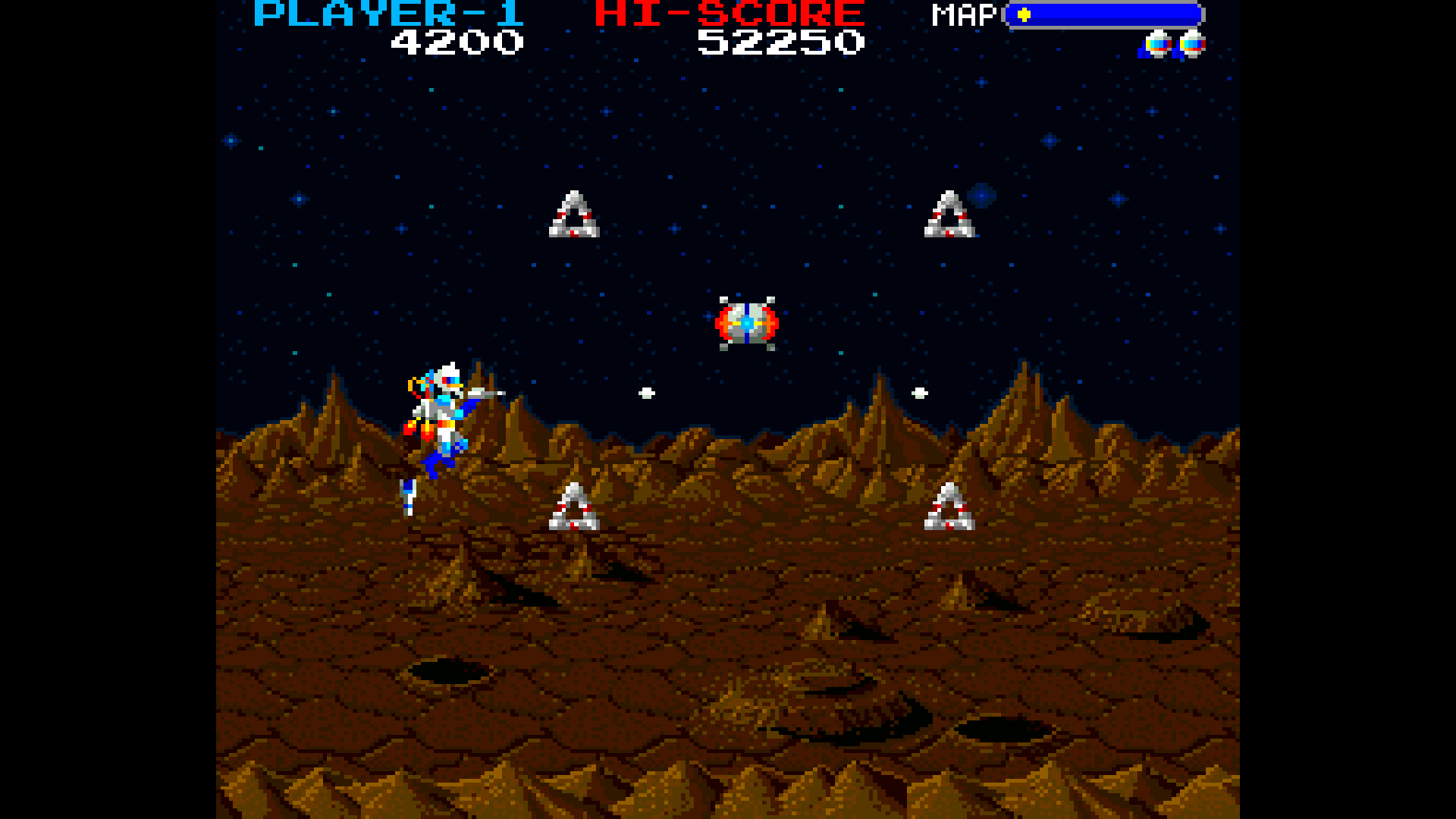
The player controls Cosmo Fighter Robin, sent to fight a mysterious army in the Fourth Galaxy. Robin begins in humanoid form, an armed figure with a jetpack rather than a permanently fixed spacecraft. Upgrades can turn the robot into Turbo Jet form, and bird-like and dog-like robots can join the attack. Each stage ends with a giant machine whose vulnerable parts must be hit. The premise is brief enough to grasp before the first coin is spent, leaving most of the game's personality to its moving machinery.
The Japanese instruction card lays out an eight-direction joystick and two buttons. A fires the blaster and missiles; B fires the options, the game's name for its supporting robots. That gives the player a separate action for the companions while the main armament deals with airborne and ground-level targets. The control drawing is small, but its labels are clear. It also explains why a description that assigns one button to the gun and the other to missiles misses part of the design.
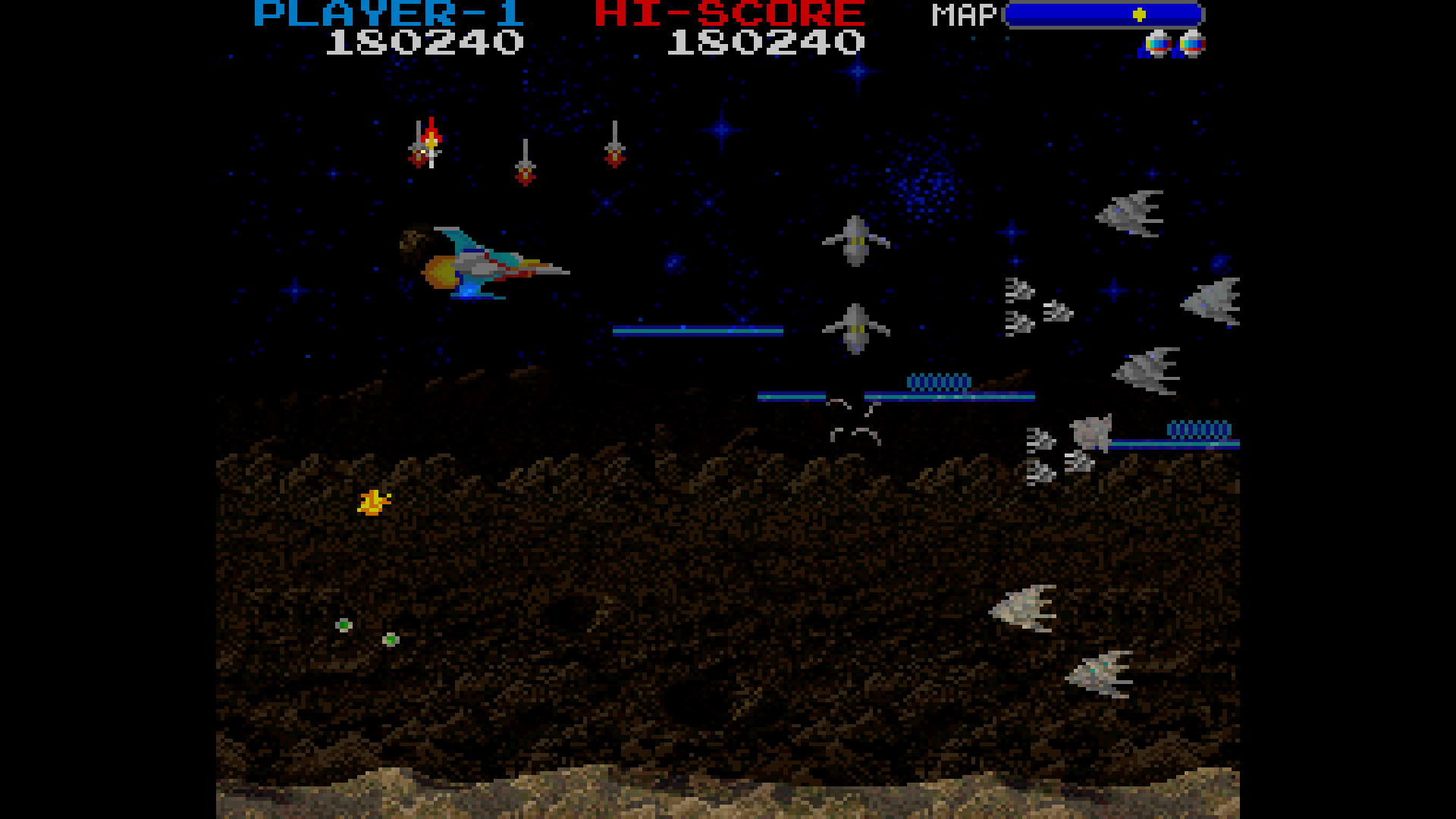
The scene rarely settles down. Robin moves through a stream of small attackers while the terrain scrolls underneath, and the weapons add several paths of fire to watch at once. A laser, automatic shots and guided missiles have different jobs within that crowded picture. The accompanying robots enlarge the formation around the player, so a successful attack depends on where the whole group is positioned. Even in the modern screenshots, the small figure has to be picked out among projectiles, pickups, flying machines and the changing surface below.
A Famitsu play discussion describes the jet as having a narrower vertical collision area than the humanoid form, which can help during boss attacks. It also reports that destroying the head or body of the first two giant machines changes their attacks. Those observations give repeated play a purpose beyond memorizing where to dodge. A player can experiment with which part to destroy first, then build a route around the resulting attack pattern. The precise damage values and every version's collision rules remain undocumented.
The form that feels safest is not necessarily the only useful one. Changing shape alters Robin's outline and the arrangement of the supporting robots. Moving into position for a ground target can expose the player to an aerial threat; chasing an upgrade can pull the formation away from a safer line. Exzisus asks for attention to those small decisions throughout the journey. Its robots and transformations are part of the fighting, rather than occasional flourishes between stretches of ordinary shooting.
The stages and their machines
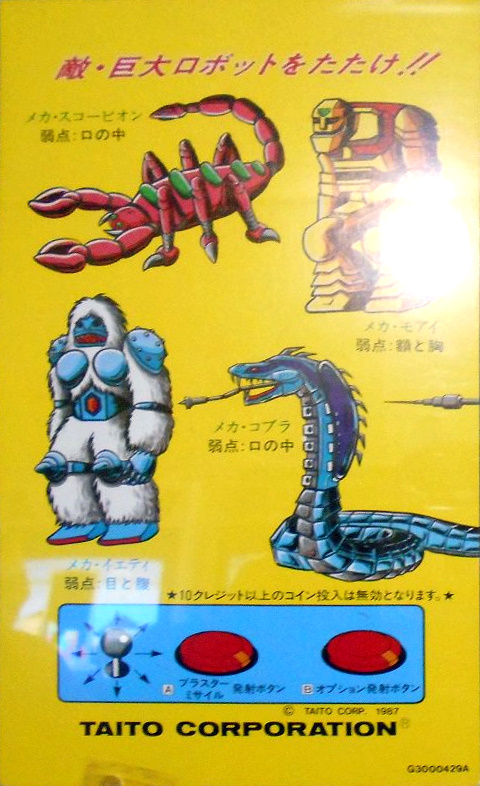
The four-stage journey passes over rocky ground, an icy world, a desert-like landscape and an industrial city before the game loops. The Japanese instruction card names the giant enemies Mecha Moai, Mecha Yeti, Mecha Scorpion and Mecha Cobra. The translations suit what appears on screen: a mechanical stone head, a shaggy-looking machine, an armored scorpion and a long coiled serpent. Each has a silhouette that can be recognized quickly, even when the player is watching small enemies and bullets around it.
The card prints weaknesses beside the figures. Mouths are identified for the scorpion and cobra; eyes and chest for the yeti; nose and chest for the Moai. Glare obscures part of the Moai illustration and some nearby print, but the broad targeting advice remains readable. A player standing at the cabinet could learn the important parts of these encounters from the artwork before reaching them. The drawings introduce the enemies and explain how to attack them in the same small space.
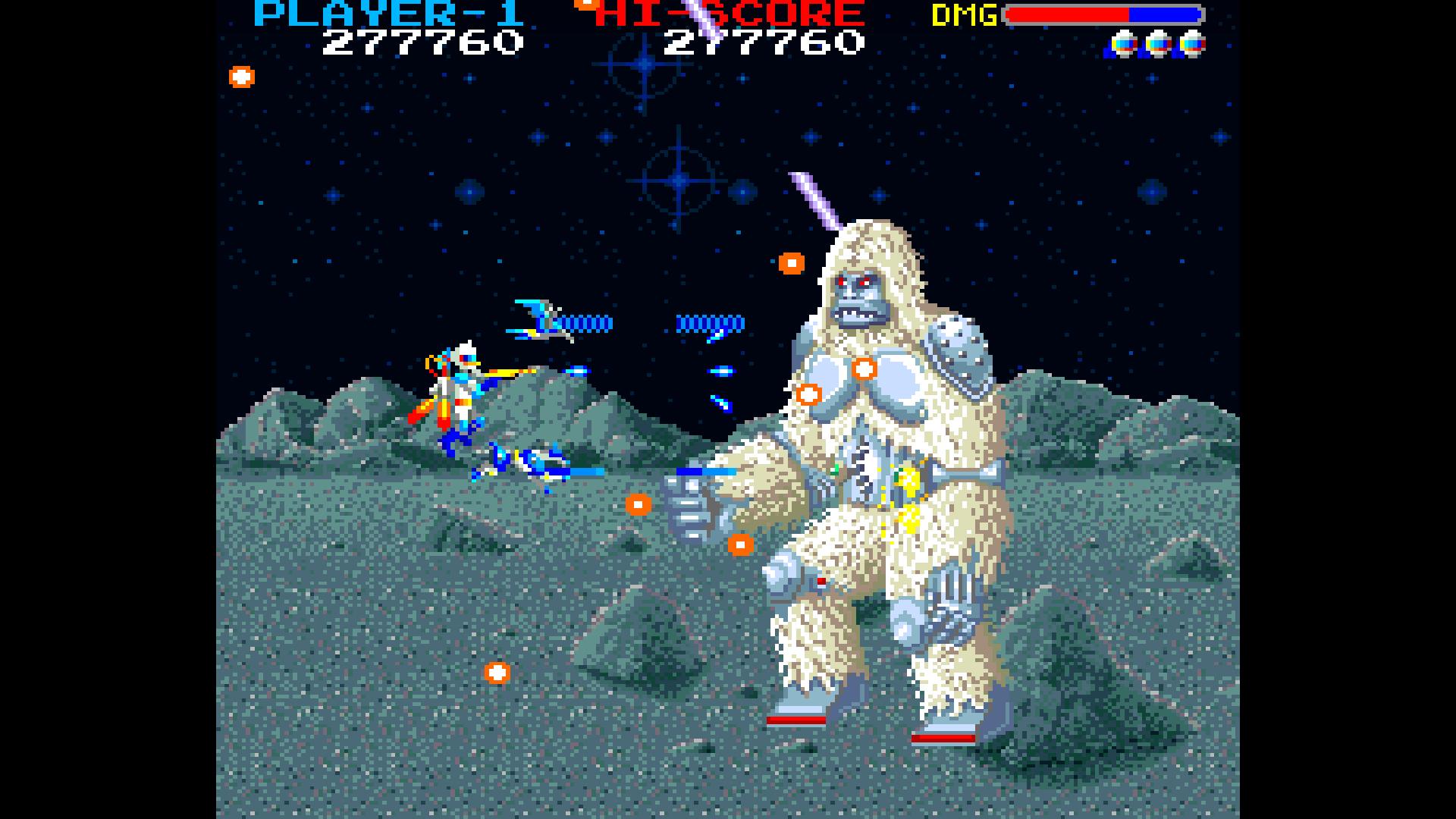
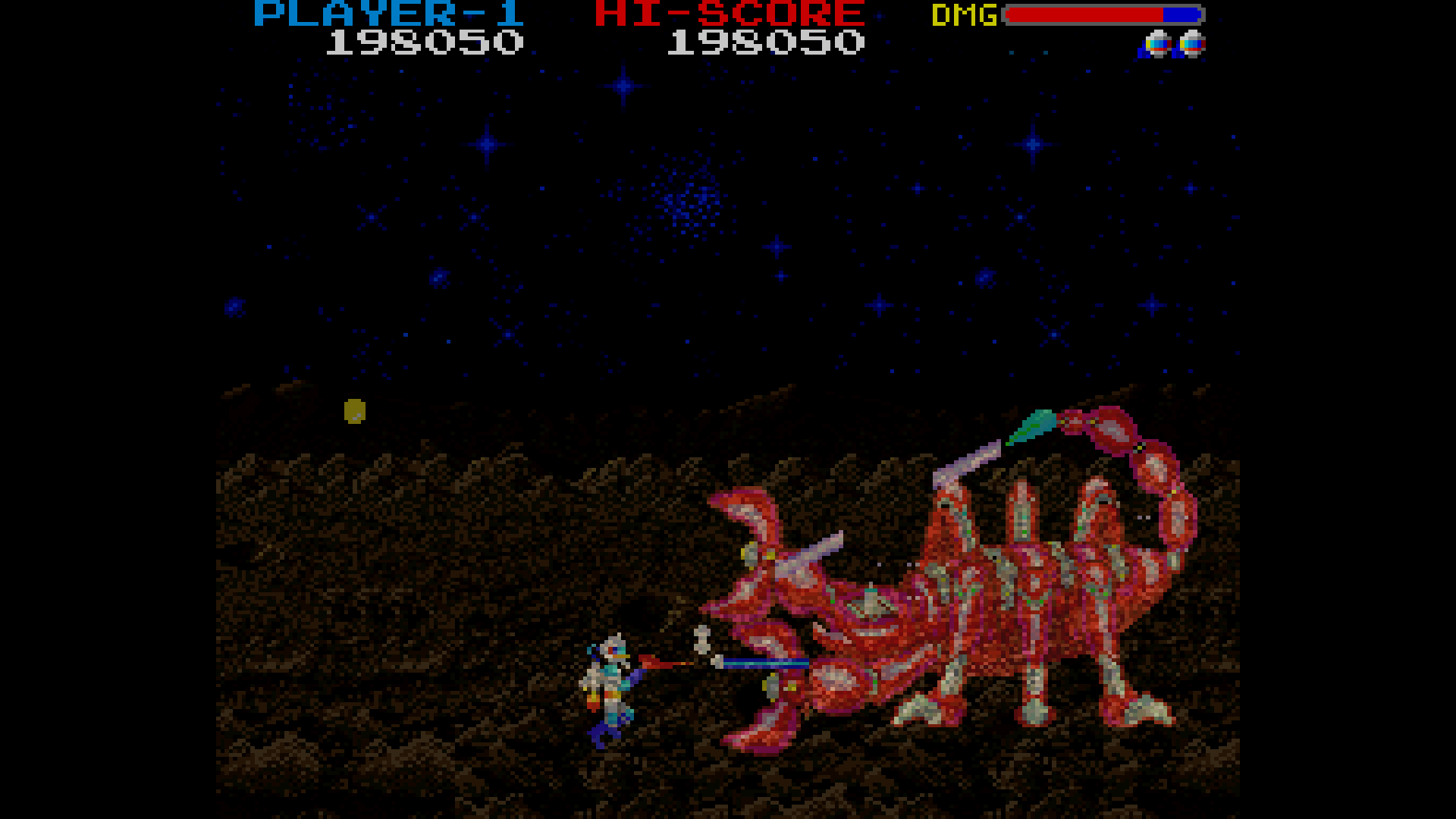
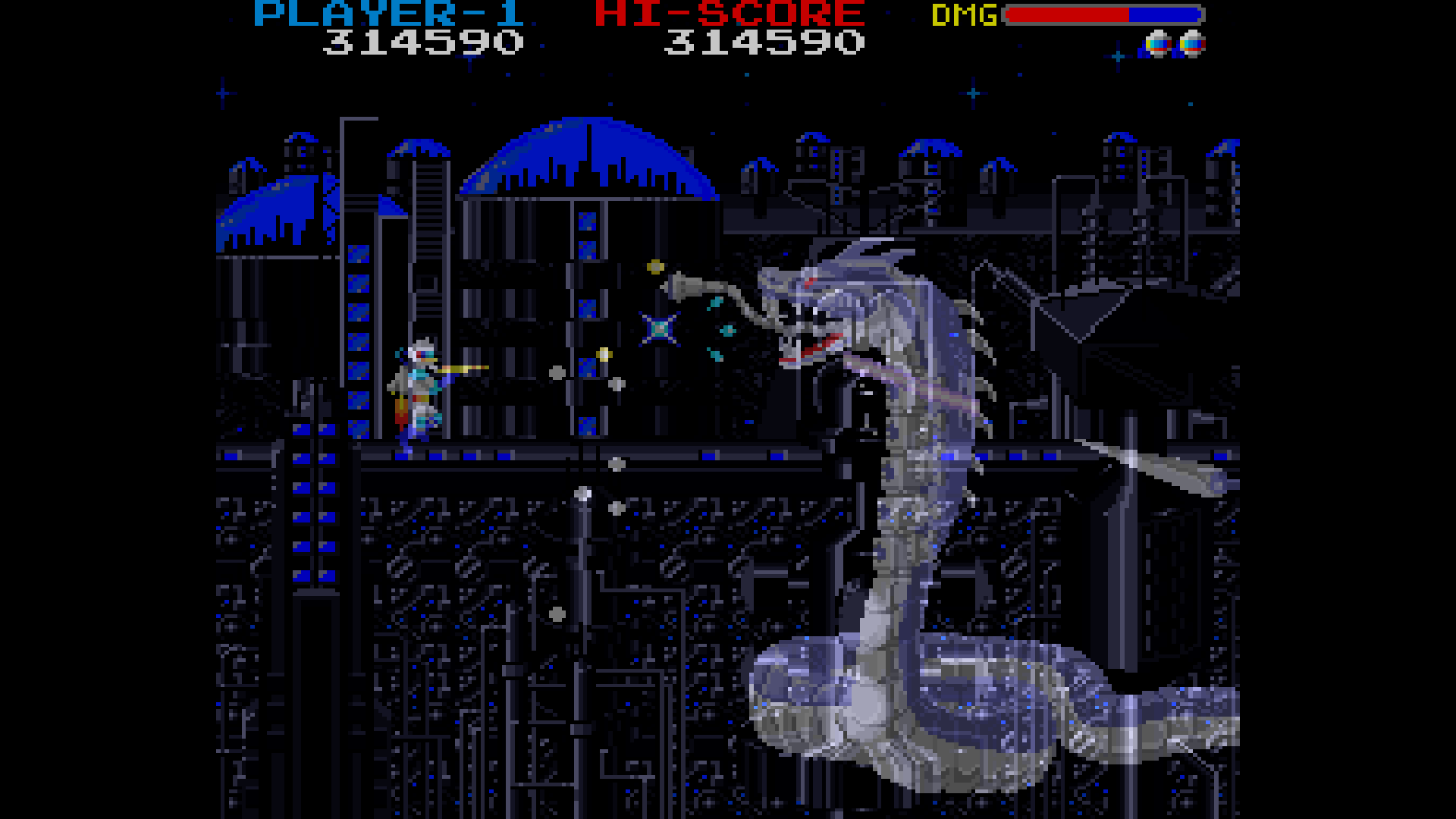
The official 2026 screenshots show how those drawings became game objects. Mecha Yeti towers above Robin on the ice, with a large rounded body and prominent limbs. The red scorpion faces the player beneath its raised tail. Mecha Cobra winds through the industrial scene, a narrow neck rising from a much larger coiled body. Their shapes leave different gaps to watch and different areas to aim toward. The Moai adds an ancient monument to this collection of machine creatures, broadening the imagery beyond conventional spaceships.
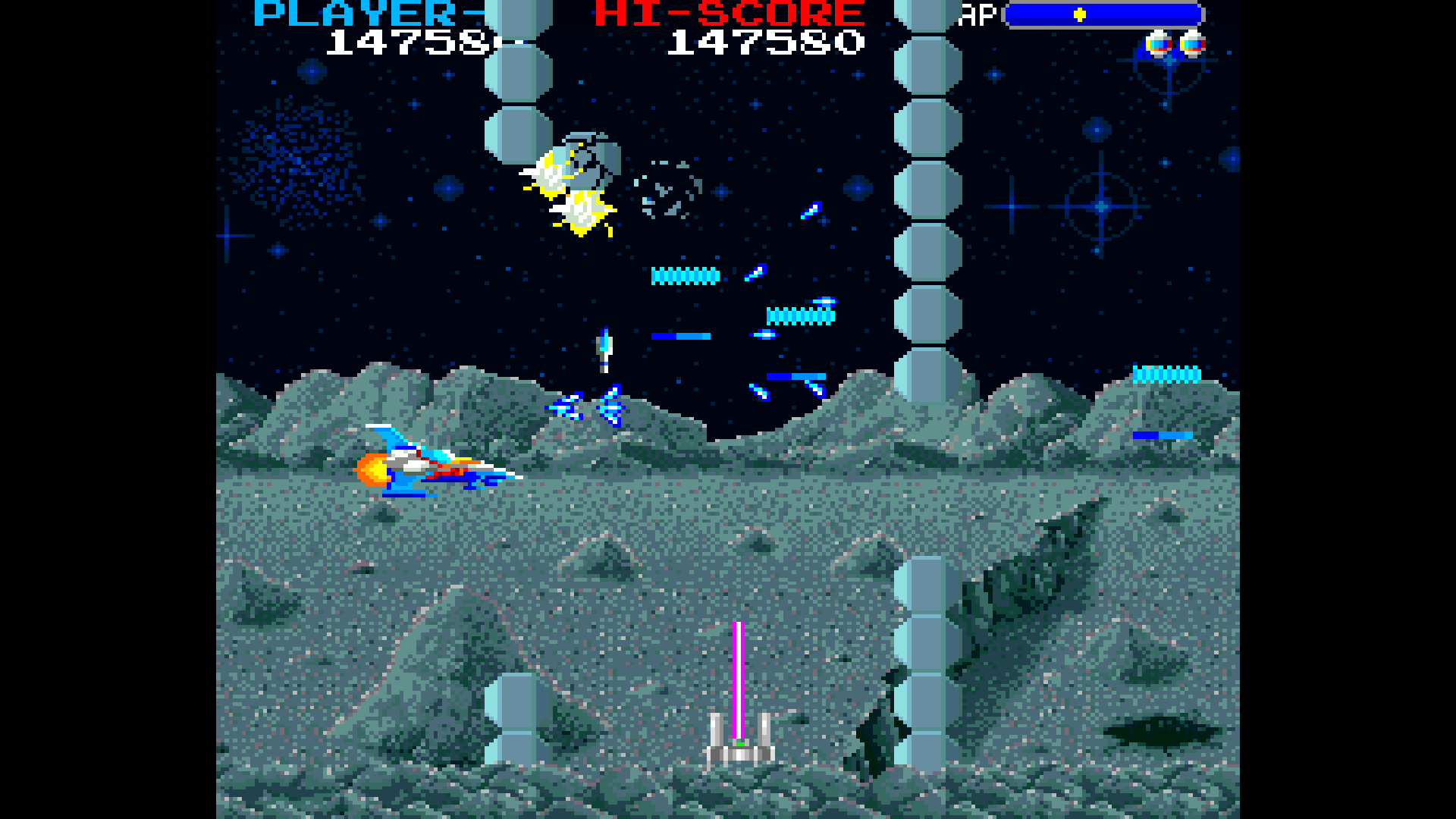
Each new landscape gives the next machine a setting. Rocky ridges, cold blue terrain and dark structures break up the trip, while the top-of-screen map marks progress through a stage. The common sequence makes the game easy to describe, but the encounters within it vary between the dedicated and conversion programs. A familiar boss or background is therefore a useful landmark, rather than a promise that the same formation will arrive in the same way on both versions.
The robot on the artwork
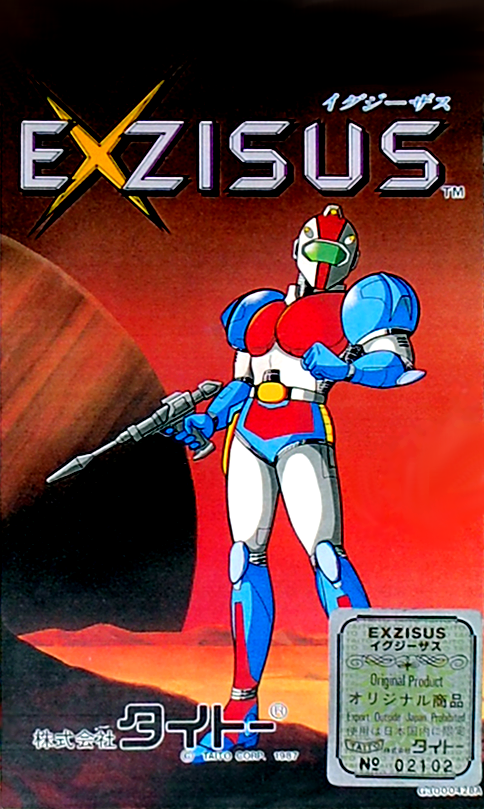
The Japanese promotional image gives Robin a much larger presence than the moving sprite can manage. Red, white and blue armor fills the foreground, a green visor cuts across the helmet, and a gun projects from one hand. Behind the figure are a large planet, a dark space background and the bright curved surface below. The metallic Exzisus lettering stretches across the top. It is a direct introduction to the game's ingredients: an armed mechanical hero, alien worlds and a conspicuous science-fiction title.
The contrast with the game screen is useful. In play, the player needs room to move among attacks, so Robin occupies only a small part of the picture. The promotional pose can display the armor and weapon in detail, giving the tiny figure an identity before it starts moving. The animal companions and giant enemies then extend that mechanical cast through the game. The art establishes a readable hero without requiring a long account of the Fourth Galaxy or its invaders.
The instruction card uses a yellow field to set off the four giant machines. Along its bottom edge, the joystick and two red buttons form a second row of bright, simple shapes. It gives the customer something useful to read while waiting for a turn or after losing a life.
The preserved promotional copy has a silver label attached near one lower corner. Its date and purpose are uncertain, and the original physical item's history has not been traced. The label and the instruction card's glare are reminders of the condition in which this printed material survived. Robin's design and the large illustrated machines remain clearly visible even where small print is difficult to read.
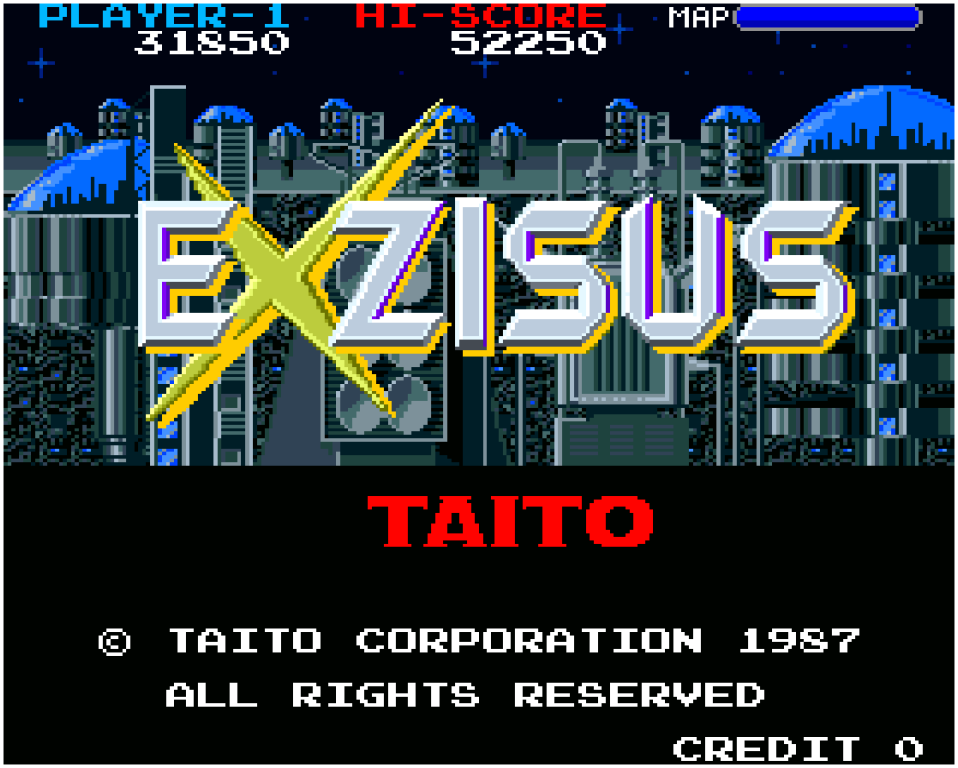
The modern title screen offers a third view of the identity. Its large logo sits over the industrial background, followed by Taito's name and the 1987 copyright. It can introduce the game on a page without being treated as an original physical marquee. The illustration, the printed card and the title screen each served a different place in a player's encounter with Exzisus, and each preserves something the others leave out.
Weapons, transformations and the art of survival
Exzisus labels its upgrades with letters. L supplies a laser, F brings full automatic fire, A is associated with the change into Turbo Jet form, and O supplies options. The preserved program text also describes guided land and air missiles. Two different D items need attention: the green Disruption pickup gives a three-way attack, while purple Destruction clears enemies from the screen. The color distinguishes their effects. B is Barrier, the defensive upgrade described for the dedicated version and reported absent from the conversion.
Changing into the jet offers an extra margin for survival as well as a different appearance. The Famitsu account describes a hit removing that form and returning Robin to a humanoid shape; it also notes the jet's smaller vertical collision area. An explanation in the original program refers to surviving four enemy hits when powered up. The available descriptions do not settle which combinations of form and protection that sentence covers, so it cannot serve as a universal four-hit rule. Form changes and Barrier need to be considered separately.
Upgrades arrive differently in the two arcade programs. In descriptions of the dedicated game, destroying an enemy formation can earn an item. In the conversion, shootable canisters deliver pickups. The first arrangement rewards completing a sequence of targets; the second puts another object among the enemies and terrain. Either way, the appearance of an item creates a decision about moving toward it. An upgrade is useful only if Robin survives the trip to collect it, and a change of weapon can alter the next encounter.
Enemy staging also changes. Accounts of the dedicated version describe machines approaching from the background and entering the foreground, an entrance that suits its separated picture planes. The conversion is reported to bring at least some of those enemies in from the edges. That gives the same artwork a different entrance and changes where the player must watch. The broad contrast is well established in version descriptions; an encounter-by-encounter comparison of both complete games has yet to be recorded.
The bird and dog robots keep the transformation theme visible during ordinary combat. They are recognizable companions rather than featureless extra guns, and the second button gives them a place in the control scheme. Together with the changing blaster and missile patterns, they turn Robin into a small fighting formation. Learning the reach of that formation, the space it occupies and the next place to move is a large part of getting comfortable with Exzisus.
The principle: two light paths, one view
A CRT makes its picture by lighting phosphors on the inside of the tube's face. In the special Exzisus arrangement, scenery and moving figures could be shown on different tubes. A partially reflective sheet of glass sent light from both toward the player: one picture was seen through the glass, and the other by reflection. The two images lined up within the same field of view. With their effective image distances separated, the foreground could appear to float in front of the landscape.
The term half-mirror refers to that combination of transmission and reflection. A coating across the viewing surface lets some light through and reflects some light back. The coating, the angle of the glass and the brightness of the screens determine how much of each picture reaches the viewer. The effect depends on the whole installation, including the dark space around the tubes, rather than on a special sort of game sprite.
A layered display gives the eye two flat pictures at different apparent distances. It does not need glasses or a separately drawn image for each eye. Robin remains raster artwork, but the artwork is seen on a different plane from the ground behind it. That physical distance is what a normal screenshot leaves out. The screenshot can preserve the shapes, positions and colors in the scene while putting them all back onto one surface.
Alignment has to be maintained across both pictures. Their sizes and positions must agree, or an object intended to pass above a feature in the landscape will appear displaced. Reflection also changes the orientation of the image, requiring a suitable screen arrangement or video orientation. Brightness needs balancing because the two light paths may lose different amounts of light. Reflections from the room, dirt on the glass and unwanted illumination inside the cabinet can all make the layered view harder to read.
These requirements explain the work a mirror cabinet has to do, but an original Exzisus mechanical drawing has not been recovered. The exact tube positions, mirror angle, viewing distance and service arrangement remain unknown. A familiar forty-five-degree diagram from another machine would be a possible illustration of the principle, not an authenticated Exzisus plan. The board and surviving accounts establish the separated images; the cabinet's precise construction still awaits an interior photograph or manufacturer's paperwork.
Taito's earlier experiment: Wyvern F-0
Taito had already built a shooter around this idea in 1985. Wyvern F-0 used two CRTs and a half-mirror to place aerial action above a ground scene. Its vertically scrolling battlefield differed from Exzisus's horizontal journey, but the separation of aircraft from terrain gave the display a clear job. Taito's own later history for the EGRET II Mini describes the arrangement, and period promotional material shows that it was part of the original attraction.
In Game Machine's May 15, 1985 issue, Taito advertised Wyvern F-0 with a cabinet picture and a description of the powerful depth effect produced by two television monitors. The advertisement appears on printed page 23. Its small gameplay pictures show the aerial-combat setting, while the cabinet illustration puts the hardware in an operator's sales context. The separate Japanese flyer combines a pilot, aircraft, sample screens and a small view of the dedicated machine, giving the otherwise difficult-to-photograph effect a conventional promotional package.
The surviving Wyvern cabinet photographs are particularly useful for reading that promotion. A former owner's front view shows the tall upright, its orange branding, the instruction area above the dark viewing opening and the two-button control panel below. Another photograph preserves the instruction card itself. The display is surrounded by a substantial enclosure, and much of the optical equipment is hidden from a player looking in from the front. These are photographs of Wyvern hardware; Exzisus-specific exterior art and internal mounting have not been authenticated.
The same former owner left an unusually memorable account of finding the machine. While helping clear an arcade that was to make way for a highway, he discovered the Wyvern cabinet behind a vending machine. Its owner said it had seen relatively little use before a monitor failure caused it to be put aside. The rescuer repaired the monitors and arranged for it to operate at another arcade. When that business closed at the end of 2000, he had to dispose of the cabinet, keeping its board and major parts.
That is a familiar problem for large arcade hardware, made sharper by the extra tubes and optical parts. A stored board occupies little space compared with the cabinet built around it. Glass, monitor mounts, wiring and the enclosure can disappear even when someone saves the working electronics. Here the owner's account preserves both ends of the story: a machine rescued because its display could be repaired, then lost again when there was nowhere to keep the whole cabinet.
He also remembered Wyvern's sound: explosions associated with aerial action came from an upper speaker, while ground effects came from a lower one. The arrangement extended the separation of air and ground beyond the picture. It is a striking feature of his Wyvern installation, although Exzisus's surviving documents do not establish the same speaker layout. The photograph and memoir supply a well-documented predecessor, with enough detail to explain the attraction of the equipment that Exzisus later used in its own form.
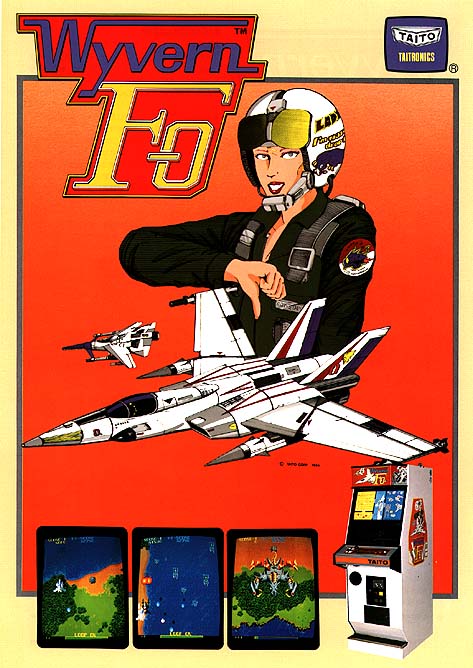
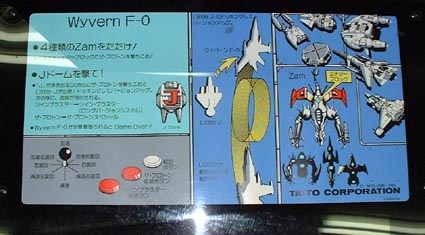
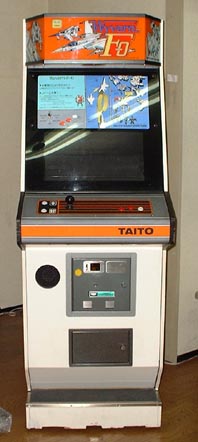
Were Wyvern cabinets converted into Exzisus?
Japanese recollections link the two games more directly than a shared optical idea. In March 2007, a commenter named tx2 recalled two local half-mirror Exzisus machines and said both had been changed over from Wyvern F-0. The recollection identifies actual machines remembered in use, although it supplies neither installation dates nor the name of whoever performed the conversions. An independent diary entry in 2013 remembers playing special-cabinet Exzisus while never having seen an original Wyvern in operation.
A later Japanese game catalog likewise describes Exzisus as reusing the Wyvern cabinet. Taken together, the accounts make cabinet reuse credible. They also suggest a practical route by which a new shooter could reach an arcade that already owned unusual display equipment. The monitors, mirror and enclosure could remain in use while the game board changed. A surviving installation sheet would help establish what additional wiring, art or mounting work accompanied that change.
The surviving recollections leave the supplier and procedure unsettled. A manufacturer or distributor might have supplied a kit; an operator might have arranged a local adaptation. Some installations might have been sold complete. Those possibilities concern how machines reached arcades, and the accounts cannot distinguish all of them. They support Wyvern-to-Exzisus conversions without establishing that every special Exzisus cabinet began life that way.
Cabinet reuse also complicates the search for photographs. A machine documented under the Wyvern name may have operated as Exzisus later, and exterior artwork could have changed without revealing the display inside. Conversely, an Exzisus board fitted to a conventional cabinet would tell a different story. The clearest surviving image would identify the title, the original board and the two-monitor assembly together. Until such a record appears, Wyvern's well-photographed exterior is a comparison rather than a substitute.
An original kit number, parts list or service document could connect these recollections to Taito's distribution arrangements. It could also explain which parts of the older cabinet stayed in service. For now, the history can follow the remembered conversions and the surviving Exzisus board, while leaving the exact factory or operator procedure open.
The original two-output board
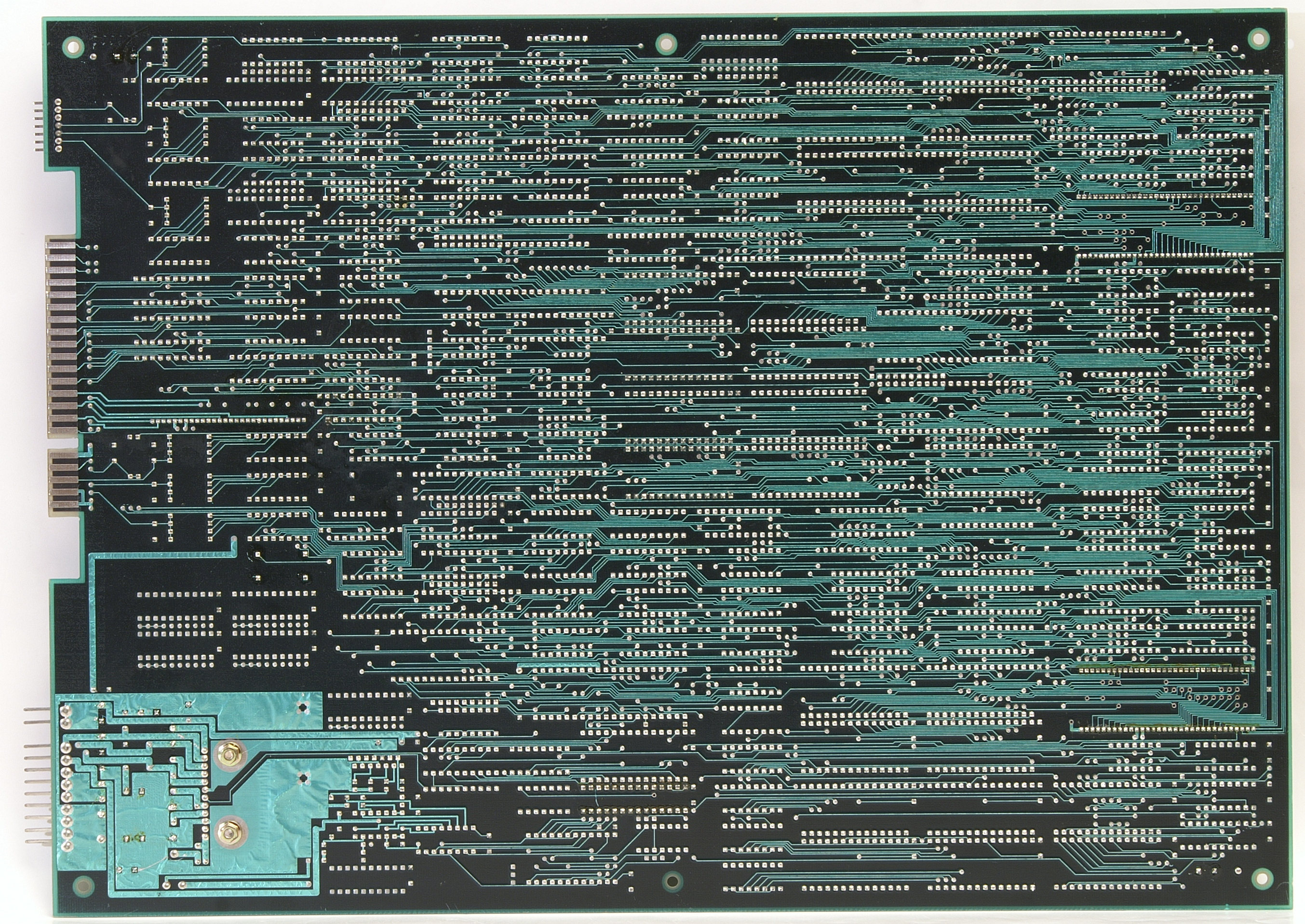
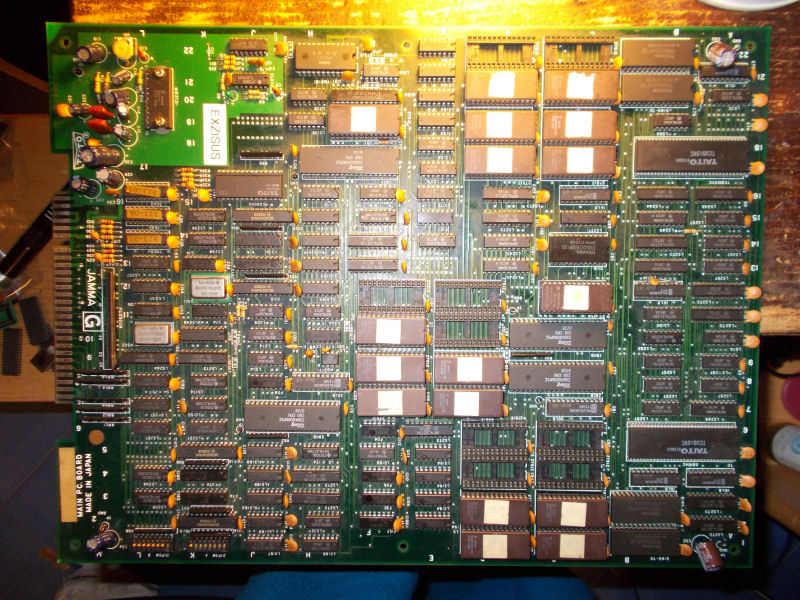
The original Exzisus board is identified in the MAME driver as K1100256A. Its background and sprite pictures leave through separate red, green and blue video connections. A later board combines the picture into one output and uses the JAMMA cabinet interface. That hardware note is the clearest technical starting point for the two versions. It also records an unresolved detail: the driver author did not know exactly how the original separate outputs were brought together in the physical machine.
MAME draws the two picture collections into a single bitmap for an ordinary display. Its rendering code handles separate graphics and object data, allowing transparent areas in the moving images to leave the scenery visible. That composition makes the game playable on a normal monitor. The code preserves the organization of the pictures, while the separate video connections and cabinet record explain why their original presentation involved more than one screen.
The Taito hardware catalog names B12 as the dedicated Exzisus form with two mirrored screens of the Wyvern type, and B23 as the standard JAMMA conversion. The driver describes four Z80 processors, a Yamaha YM2151 sound chip and two TC0010VCU graphics devices. Those identifiers connect the software entries to actual board designs. They also distinguish the game's compact raster picture from the number of tubes used to present it: one visible scene could still have been assembled from two separate sources of light.
Stefan Lindberg's board collection supplies a firsthand account of using the original hardware. His Exzisus board had two RGB outputs and came with an adapter joining them for one monitor. It produced a playable image, although he found the sprite layer partly transparent. The board also had intermittent work-RAM trouble and did not always boot. The accompanying component-side and solder-side photographs preserve the board as an object, including its connector layout and identification markings.
The adapter let unusual hardware survive outside its intended cabinet. It could combine enough of the picture for a player to use the board, even with the optical apparatus missing. The partly transparent foreground in the owner's account is also worth remembering when looking at later screenshots: an image from a makeshift combined-output setup may show the behavior of that setup as well as the game. The adapter's circuit and the original factory display wiring have not been documented together.
A Stefan Lindberg is credited alongside Phil Bennett in the later preservation history of the dedicated program. The name and subject suggest a connection to the collector's board, but the published accounts do not independently identify them as the same person. Both records remain useful in their own right: one describes surviving hardware, and the other credits the recovery of its software.
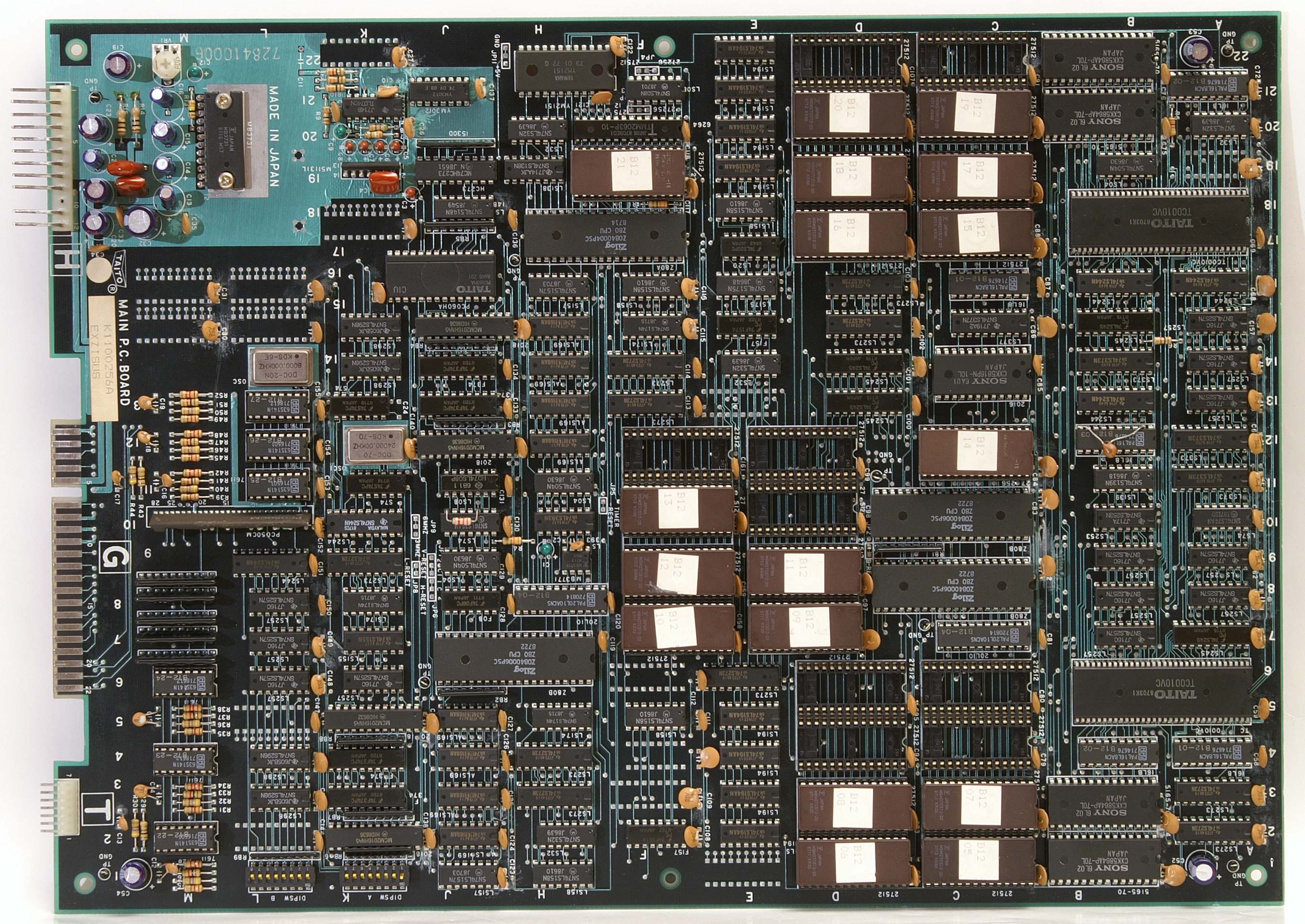
Building the picture from small pieces
The MAME implementation shows how the broad scenes and large machines can be assembled from much smaller graphics. Its basic patterns are eight pixels across and eight pixels high. Groups of those pieces form the objects and landscape visible during play. A repeated patch of ground does not have to be stored as an entirely new full-screen painting every time it moves. The board can select patterns, place them and choose their colors, building a busy scene from a limited collection of reusable parts.
Two graphics sections are represented in the driver, with separate object and video data. The refresh routine works through each collection to construct the combined view. One object format makes a sixteen-by-sixteen-pixel figure from four small patterns; another arranges patterns into a tall sixteen-pixel-wide column. Those columns can supply larger stretches of scenery. Different arrangements of the same small building blocks allow the picture to cover much more space than any one basic pattern.
That helps explain the mixture visible on screen. Small attackers can cross a landscape built from repeated surface details, while a much larger machine can be made from a collection of graphic parts. The resulting scene contains a small player, many independently placed threats and enough background detail to suggest a different planet.
The emulator's visible picture is 256 pixels wide by 224 high. That is the logical game image, rather than a measurement of either original television tube. Colors come through a palette defined with the game's PROM data, and transparent graphic areas allow one collection to show through another. On an ordinary display, the completed picture is drawn into one surface. The original two-output board could carry its scenery and moving action to different displays before the cabinet combined their light.
Sound has its own path through the electronics. A separate processor runs the audio program and communicates with the game through Taito's sound-interface device. The YM2151 supplies the synthesized output, followed by the circuitry that makes it audible through the cabinet. The later repair account follows part of that physical chain when it traces missing sound to an amplifier stage. Keeping music running, moving the scenery and updating the enemies are coordinated jobs spread across the board's components.
The small patterns, object placement and picture composition survive in the emulator. The two-output board connects that digital construction to the cabinet: scenery and action could leave by separate connections, then meet again as light in front of the player.
Darius and the wide-screen alternative
Darius used mirrors to make a much wider battlefield. The original game combined three CRT views into a panorama across which enemies and scenery could travel. An April 1987 BEEP! feature on its development, available in translation, explains how the left and right monitors were placed below the playfield and their pictures reflected into position. This avoided simply lining up three bulky tubes with broad gaps between them. The mirrors helped conceal the physical boundaries of the displays.
Wyvern and special-cabinet Exzisus used their images over roughly the same viewing area. One plane supplied the landscape, another supplied moving action, and the difference in apparent distance gave the scene its layered character. Darius extended the scene sideways. The distinction is easy to miss when all three games are described as Taito experiments with several monitors, but a player encountered very different spaces through the cabinet glass.
The Darius feature places the idea within a longer Taito history, mentioning earlier mirror work and Wyvern's combination of two monitor pictures. That makes the relationship more concrete than a resemblance noticed decades later. The company had practical experience arranging CRTs, managing reflected images and building a cabinet around the resulting view. Exzisus belongs to that period of experimentation even though its own surviving mechanical record is much thinner than Darius's.
The games also present different problems for modern displays. A wide digital canvas can carry the full Darius panorama, provided it is shown at a useful size. Combining Exzisus into a single canvas puts near and far onto the same surface. The action survives, but changing the screen size alone cannot restore the original spacing of its image planes.
Exzisus in an ordinary arcade cabinet
An arcade operator installing B23 needed a suitable conventional cabinet and monitor. Installing the dedicated version meant accommodating separated pictures and the special display. The choice affected the equipment on the floor as well as the game customers played. A single-output conversion could make Exzisus available in an arcade that had never owned the optical cabinet, while a Wyvern conversion could keep an existing mirror installation earning with a different game.
The photographed boards make that difference tangible. Lindberg's board carries the K1100256A identification, and the later board in Caius's repair account has JAMMA printed beside its edge connector. The latter could connect through the common cabinet interface for power, controls, sound and video. B23 was still an Exzisus board, with its own program and graphics data; the standard connector simplified its relationship with the cabinet rather than turning it into interchangeable software for any other game board.
The conversion also involved program changes. The preserved data and reported play differences show that it was more than a switch that disabled the mirror. Some graphics and program material stayed closely related, while other portions changed substantially. That mix fits the practical job of carrying the same game into another presentation. The surviving evidence does not establish that a lack of processing power forced the differences, or that every change was made solely to accommodate one monitor.
The appeal of a normal cabinet is easy to understand: one monitor is a more familiar service problem than two tubes aligned around a mirror. Existing controls and an established wiring interface could remain useful. The actual commercial terms are harder to recover. No verified Exzisus price list, production total or comparative earnings record survives in this collection, so the equipment requirements explain an operator's options without supplying a precise calculation of costs or profits.
The word conversion can therefore describe two different events in this history. A Wyvern cabinet could receive Exzisus while retaining the layered display, or a conventional arcade cabinet could receive the single-output B23 board. The first changes the game within unusual hardware; the second makes the game available through standard equipment. The recollections and board records become easier to follow once the cabinet being converted is identified.
Brightness, alignment and the cabinet glass
The viewing position matters too. A cabinet needs an opening large enough to see the intended scene and an arrangement that keeps both pictures aligned from where the player stands. The enclosure helps define that position. Moving a camera into the opening, changing focus or exposing for one bright part of the picture can change how a photograph represents it. A front photograph is valuable, but it cannot be expected to convey the depth as clearly as standing at the machine.
Darkness plays a practical role. Black areas on a CRT produce little light, allowing the other screen's picture to remain visible through the combined view. Light from foreground and background can still contribute to the same area, so brightness balance affects whether a figure looks solid or faint. An electronic mixer feeding a single monitor has its own way of combining those signals. Lindberg's partly transparent sprites belong to his adapter account; they do not establish an intended transparency effect in every original cabinet.
Service access would have to protect that alignment. A monitor could be electrically healthy yet leave the scene looking wrong if it moved or its image size changed. Dirt and room reflections could weaken a perfectly working game picture. These are ordinary consequences of combining luminous displays through glass, and they help explain the amount of physical equipment surrounding the software. The original Exzisus adjustment procedures, however, are among the details still missing from its service record.
The most useful cabinet evidence would show the optical assembly as well as the outside of the machine. Tube mounts, glass, cabling and the space between them would answer questions that a title screen cannot. Until that evidence is recovered, the board gives a firm electrical starting point and Wyvern supplies a documented physical precedent. A reconstruction can illustrate how the method works, but its measurements should remain distinguishable from Taito's original Exzisus design.
Exzisus in Taito's 1987 arcade market
Exzisus carries a 1987 copyright, and Taito's modern publisher documentation uses the same original release year. Later catalogs give August as the Japanese launch month. The narrower date has not yet been matched to a dated original shipping announcement or advertisement. It belongs in the chronology as a reported month, alongside the more securely established year, rather than as a precise day on which every form of the game reached every market.
The two board forms also leave more than one event to date. A dedicated installation, a standard-cabinet conversion and a licensed regional version could reach operators on different schedules. Product codes distinguish the equipment but do not supply those dates by themselves. The order in which programs later appeared in an emulator is a separate history. The surviving record is strongest when it names the version and the kind of release being discussed.
Game Machine's October 1987 charts show the crowded market around the game. R-Type, Double Dragon, 1943 and Psycho-nics Oscar appear with Taito's Arkanoid: Revenge of DOH in the table-video list. The upright and cockpit category contains Darius, Midnight Landing and After Burner. Operators were choosing among board-driven games that fit familiar cabinets and large attractions whose hardware was part of their draw. Exzisus's two forms offered routes into both kinds of installation, although its own comparative earnings have not been recovered.
Some later accounts give Exzisus a nineteenth-place Game Machine ranking in October. The inspected October 1 and October 15 charts name other games in that position, so that figure cannot presently support a sales story for Exzisus. Its original commercial performance remains uncertain. Sparse photographs and present-day collector rarity tell us how difficult the equipment is to find now; they do not provide a reliable count of how many boards or cabinets originally left Taito.
Initials inside the program
Two programmer names survive in the original program material: T. Yoshikawa and T. Murata. They occur in both the dedicated and conversion data, connecting the related versions to the same abbreviated credits. The strings are a modest fragment of the original staff record, but an important one in a game whose makers otherwise receive little space in its surviving documentation.
MobyGames expands those credits to Tsutomu Yoshikawa and Takeshi Murata. The full names remain a secondary identification; the original program establishes the initials and surnames. No recovered staff list assigns the artwork, sound or cabinet engineering to named individuals. The programmers can be credited for the role actually recorded without turning them into an undocumented design team or attaching particular enemies to either person's biography.
The soundtrack on record
The YM2151 gives Exzisus its FM-synthesized sound. The score is one of the game's most persistent attractions: the Japanese board owner singled out the opening music, and the 2006 coverage of its coming PlayStation 2 compilation also drew attention to its brisk soundtrack. Those comments come from different encounters with the game, long before the latest release. The music found an audience even where the rare cabinet did not.
Taito Digital Sound Archives — ARCADE — Vol.2 included Exzisus on a two-disc Wavemaster album released on February 25, 2015. The official ZUNTATA listing identifies it among the games recorded digitally again from arcade boards. The catalog numbers are WWCE-31360 and WWCE-31361. This gives the soundtrack a documented life on record, alongside other Taito games, and preserves a board-sourced performance of the music outside the cabinet that originally played it.
Exzisus BGM1 also appears in the official playlist for ZUNTATA NIGHT 3, the June 2011 broadcast, where its listed album is Legend of Game Music 2. The track had therefore remained in Taito's listening repertoire across different releases and formats. These records help follow the soundtrack's survival, although neither supplies a named composer for the original game. A later Japanese music catalog describes an unidentified external contributor, an attribution that remains qualified until its underlying credit is recovered.
The sound has survived more conveniently than the optical machine. A recording can carry its melodies and instrumental colors to a listener without the original monitor assembly. It leaves the cabinet's listening arrangement unresolved: the speaker separation described by the Wyvern owner has not been established for Exzisus. The available soundtrack records preserve what can be heard, while the physical installation remains another part of the game to document.
Three preserved sets and a one-byte distinction
MAME identifies the Japanese dedicated program as exzisus, the Japanese conversion as exzisusa and the TAD-licensed variant as exzisust. B12 belongs to the dedicated form; the other two belong to the B23 family. These names are useful when choosing a program or comparing an account of play. The emulator's parent-and-clone arrangement organizes the preserved versions; its choice of a parent is not itself a dated record of the game's original distribution.
The compared Japanese conversion and TAD archives contain eleven files identical in both name and contents. Their remaining program files have different labels but differ by exactly one byte; the other bytes match. That is a remarkably close relationship between the two preserved sets. The one changed value has not been traced to its purpose, so the comparison stops short of calling it a territory selector, a copyright switch or a change to the fighting.
The program data also contains several copyright and territorial strings, including material associated with Japan, Taito America and TAD. Software can hold text that does not appear during every boot or operating mode. Identifying the words in the data is therefore only part of identifying a particular machine. The licensed TAD form is established in the preservation record, while its exact original shipping history and the function of that changed value remain open.
The dedicated and conversion archives differ much more widely. They contain different arrangements of program and graphics material, with some compared areas very close and others substantially changed. The supplied dedicated archive also has more members and more uncompressed data. An archive's size reflects how its files were packaged, including any shared material; it is not a direct measurement of the physical board's memory. The comparisons establish related but distinct program collections.
That evidence fits the differences remembered by players. The dedicated game has its own program and presentation, the ordinary conversion revises them, and the TAD set is closely related to the conversion. A small territorial change and a substantial gameplay revision can coexist within one game's preservation history. Exzisus needs all three identities kept visible, rather than one undifferentiated program standing for every arcade version.
Playing for another life
An operator could select two, three, four or five starting lives. The documented bonus choices also vary: 100,000 points followed by each additional 150,000; a default of 150,000 followed by each additional 200,000; or a single extra life at either 150,000 or 200,000. Those are the switch interpretations recorded by MAME. A run's starting conditions therefore matter when comparing how far two players got, even before differences between the dedicated and conversion programs enter the discussion.
The default is a starting point for understanding a preserved configuration, rather than a record of every arcade's choices. Difficulty, starting lives and bonus awards were part of operating a board, and a particular cabinet could have been set differently. Modern rapid-fire options add another variable to how the game feels. A useful score comparison names the program and settings, allowing the performance to be understood alongside the conditions under which it was achieved.
For a first approach to the bosses, the instruction card gives a better guide than simply firing into the largest object. Its mouth, eye, nose and chest labels direct the player to particular regions of each machine. The giant bodies occupy much of the view while Robin remains small, so positioning has to leave both a line of attack and room to move. Learning one attack pattern at a time is more useful than treating each boss as a stationary target with one interchangeable weak spot.
The same patient approach helps with the options. The companion robots have their own button and their own reach around Robin. Before chasing a high score, it is worth learning what they do in the available forms and where they leave the formation exposed. The jet's narrower profile may make a section more comfortable, while the humanoid shape changes the arrangement again. These are practical things to watch during a run, rather than a claim that one form solves every encounter.
Choose the version before learning a fixed route. Formation-earned items give a reason to finish a line of enemies; a conversion's canister asks for attention to a separate target. Barrier changes the player's available protection in the dedicated game. Someone following footage from another program may recognize the terrain yet find that an expected reward or entrance is different. Keeping the version in view avoids turning an otherwise helpful route description into a source of confusion.
MAME and the recovery of the dedicated program
Exzisus appeared in MAME 0.37b16, released in July 2001, with Yochizo and the RAINE team credited in the preservation record. The present driver still thanks Richard Bush and acknowledges its dependence on RAINE's earlier work. That connection places the game within the cooperative work of arcade emulation, where knowledge of a board and its video system could move between projects and continue to be refined.
The dedicated Japanese program arrived in MAME 0.134u1 in September 2009. The preservation history credits Stefan Lindberg and Phil Bennett, and the naming changed to accommodate the newly supported form. The previous Japanese exzisus became exzisusa, identified as the conversion, while the dedicated version took the parent name exzisus. This was a consequential change for anyone whose collection or memory of the game had formed around the older entry.
A player returning years later could select the same familiar title and meet a different program. Enemy arrangements and pickups remembered from the conversion would not necessarily line up with the dedicated game now presented as the parent. The naming history helps explain those recollections without requiring either player to have remembered the game incorrectly. Both programs had circulated under a title that did not always advertise the distinction.
The TAD-licensed set followed in MAME 0.144u3, released in December 2011. That dates its addition to the emulator, while the game's 1987 label belongs to the original arcade identity. The date on which TAD supplied its particular version to operators has not been independently established. Emulator additions, preserved copyright years and commercial release dates answer different questions, and Exzisus's chronology benefits from keeping them apart.
All of these programs can be shown through MAME's digitally composed picture. The moving art and game rules can survive on hardware with one ordinary screen, even when the original cabinet has been lost. The dedicated program's recovery was therefore a substantial step forward in 2009. Its special monitor assembly is the part that still cannot be recovered merely by selecting that entry.
The conversion version's green tint
The conversion and TAD programs have a known color problem in MAME. Issue 08899, submitted in August 2024 against version 0.268, records a greenish cast and remains marked confirmed and open in the retrieved record. A developer identifies a bad color-PROM dump as the cause. The dedicated parent's palette differs, so its data cannot simply be substituted as a correct repair for the conversion.
The color PROM is part of the board's definition of the picture. Its data helps turn stored graphics into the colors the monitor displays, so a faulty read can affect the whole scene even while the program runs. A file archive can be intact and still preserve that imperfect read. The problem belongs to the surviving dump, rather than necessarily to a deliberate green tint on original conversion hardware.
This matters when screenshots are placed side by side. A dedicated view and a green-tinted conversion view may look like an intentional change in the artwork when the palette fault accounts for much of the difference. Corrected comparisons need the program identified and the dump's limitations stated. The official 2026 screenshots and real-board photographs provide other visual records, each with its own display and capture conditions.
A monitor photograph also contains choices made by the camera and the person adjusting the screen. Brightness, exposure and reflections can change its appearance. The repair photographs are excellent evidence of the shapes of a graphics fault and its recovery, but they are not calibrated color references. Keeping those uses clear makes the surviving pictures more informative without demanding that every image perform the same job.
Repairing the conventional board
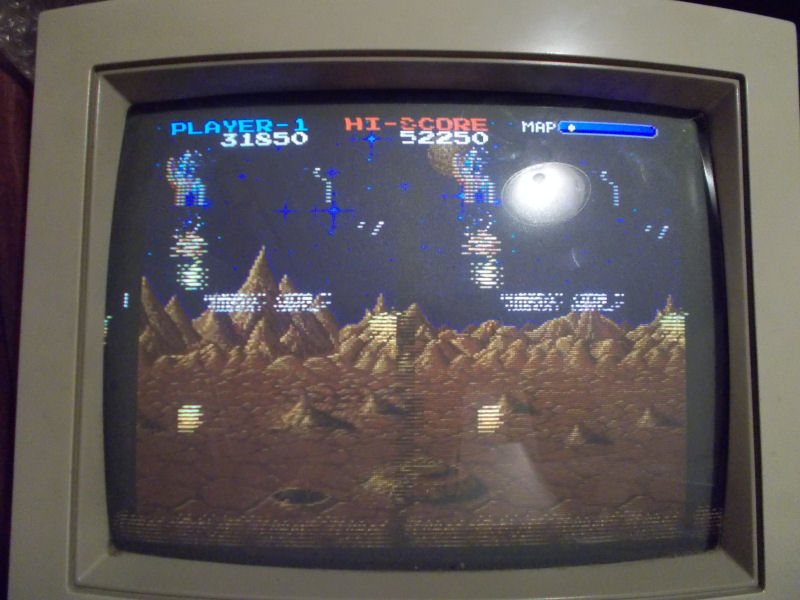
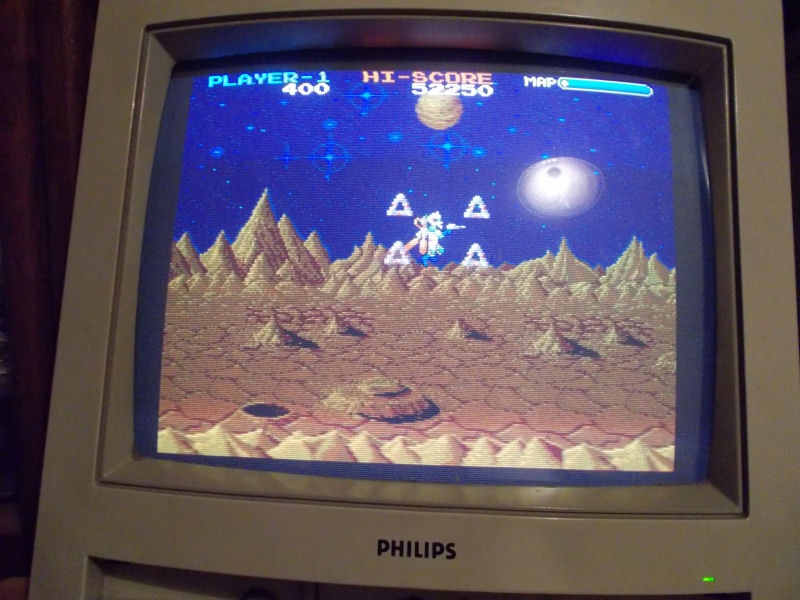
On November 21, 2015, Caius published a repair of a faulty single-output Exzisus board at JAMMArcade. It had two conspicuous problems: corrupted sprites and missing sound. The board photograph identifies the conventional JAMMA form, while the screen photographs show what the graphics failure looked like during use. Foreground figures had become repeated, shifted horizontal lines, laid across scenery that was still recognizable.
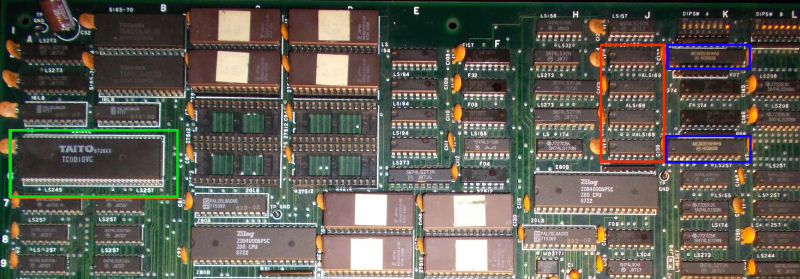
The investigation followed the sprite circuitry through a TC0010VC graphics device, RAM, latches and counters. Several 74ALS169 counters failed testing. Replacing them restored the sprite picture. The repair photographs include an annotated board detail that helps connect the on-screen corruption to the physical circuit. A large custom chip could have looked like the obvious suspect, but the failed supporting logic supplied the actual repair in this case.
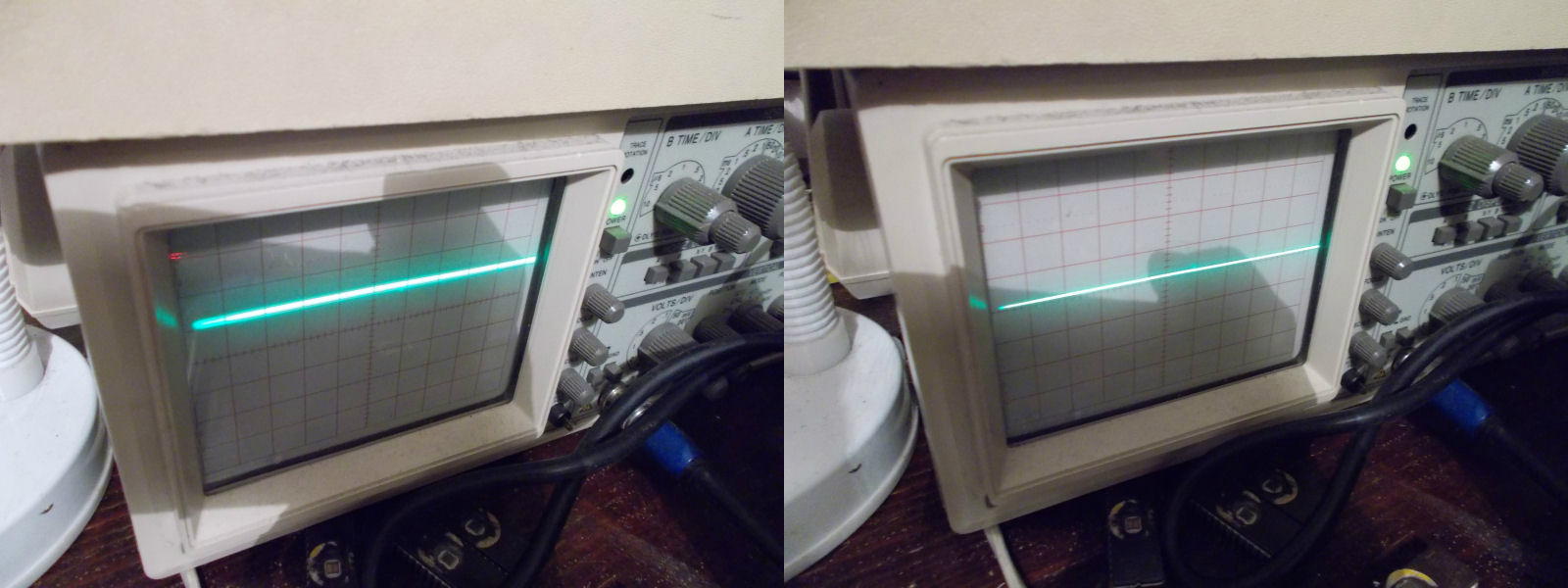
The sound fault led elsewhere. An external amplifier could reproduce audio earlier in the signal path, establishing that the board was generating it. The signal then failed to pass correctly through a TL074CN operational amplifier. Replacement at J21 restored the sound. The paired oscilloscope photographs belong to that investigation, providing a record of the repairer's measurements rather than a general diagram of the whole game's audio arrangement.
The two faults tell different stories within the same board. The running program was still producing a scene, but failed graphics logic scrambled its moving objects. Audio existed inside the circuit, but a later stage kept it from being heard normally. The repair brought those outputs back without replacing the game with another program. It shows how much of an arcade board's life continues in the small components around the better-known processors and custom devices.
The before-and-after screen photographs deserve space beside the cleaner promotional screenshots. They show Exzisus as equipment someone had to diagnose and maintain, with an actual route back from failure. They also preserve the ordinary conversion independently of the unusual original display. The repaired B23 machine is a different part of the game's survival story, one that can be followed from board markings to a working picture and restored sound.
Taito Legends and Taito Memories II
Taito Legends brought Exzisus to PlayStation 2, Xbox and Windows in 2005. The English Windows manual includes it among the collection's games and documents the surrounding menus, game options, control configuration and high-score features. For a player without access to an Exzisus board, the compilation offered a straightforward way into the game. It could be selected from a library of Taito titles and played on the same home machine as far more familiar arcade names.
A disc bought for Space Invaders or Bubble Bobble could also introduce an unfamiliar robot shooter. Exzisus sat beside games with very different controls and styles, all accessible from the collection's menu. It no longer required a chance encounter with a particular arcade cabinet: anyone exploring the disc's less familiar titles could give it a try, return to it and compare it with the better-known Taito games around it.
Japan's Taito Memories II Joukan followed in 2007. Contemporary reporting in December 2006 announced January 25 as the planned launch date and listed Exzisus among its twenty-five games. The report mentioned enemies arriving from both sides and the appeal of its fast music. Those details show what caught a later writer's attention when the game was presented again: the pressure of the shooting and a soundtrack that still stood out nearly twenty years after its arcade release.
Later comparisons identify these compilation versions with the single-screen game. The available evidence does not provide a published inventory of every program on each release, so the identification remains tied to those accounts. It nevertheless distinguishes the compilations' role from the later recovery of the dedicated form. Exzisus had a home audience well before 2026, even though many of those players encountered the conversion rather than the rare optical version.
The gap between an old arcade release and a modern revival is therefore not empty. The name, music and much of the fighting had already traveled through licensed compilations. The dedicated program's later emulation added another route into the game. What remained hardest to carry forward was the cabinet experience itself, especially the separation between its luminous picture planes.
November 2026: a standalone revival
HAMSTER released Exzisus on November 5, 2026 for five console platforms. Arcade Archives covers Nintendo Switch and PlayStation 4; Arcade Archives 2 covers Switch 2, PlayStation 5 and Xbox Series X|S. The announced United States launch prices were $7.99 for the former and $9.99 for the latter. The release gives the game a standalone place on current machines, rather than requiring a player to find one of the older compilation discs.
Famitsu's report of the October announcement said both historical arcade forms would be included. A separate pre-release play discussion repeated the inclusion of the two-screen version. That is the part of the release most closely connected to Exzisus's unusual hardware history. The reports establish the announced content, while the exact version-menu wording and optical display treatment have not been independently examined across all platforms.
Arcade Archives and Arcade Archives 2 describe HAMSTER's modern editions, rather than the old B12 and B23 board identities. The standard modes are Original, Hi Score and Caravan, with Time Attack added in Arcade Archives 2. Original mode supplies conveniences for revisiting the game, including button remapping, rapid fire, saves and rewind. Score modes put the old competition for a better result into an online ranking system, and the newer edition also supports variable refresh rate.
Time Attack changes the immediate goal from accumulating points to finishing quickly. That sits alongside the ordinary appeal of learning an enemy route and protecting a run long enough to reach the next stage. The modes offer several reasons to return to a short arcade game without changing the fact that its original one-to-two-player arrangement is alternating play. The product does not include a network cooperative mode; online score rankings are a separate feature.
At the United States launch, qualifying Switch or PlayStation 4 owners could buy the corresponding Switch 2 or PlayStation 5 edition for $2.99 using the same account. The discount does not apply in the reverse purchase order, and saves are incompatible between the modern product lines. Six supported languages apply to menus and manuals, not six newly translated versions of the original game. These details matter when choosing an edition, particularly for someone returning to Exzisus on a newer machine.
HAMSTER's 630th Arcade Archiver program was devoted to Exzisus on release day, with Taito representatives and members of the New Japan BGM Philharmonic Orchestra announced as guests. The accompanying attention brought the game and its music together again in public view. The episode listing does not identify those guests as the original 1987 team, but it records a contemporary occasion for discussing a game whose hardware and soundtrack had survived through several quite different routes.
The missing Exzisus cabinet
The largest gap is still the original Exzisus optical assembly. An authenticated interior photograph, service drawing or conversion instruction could settle the tube positions, mirror geometry and wiring. A kit number or shipping record could help explain whether particular machines were supplied complete or converted from earlier equipment. The surviving board, period Wyvern material and eyewitness accounts provide a strong outline, but leave those physical and commercial details unresolved.
Other missing pieces concern the original staff and programs: a complete creator list, the composer's identity, the TAD file's changed value, and a controlled comparison of the two arcade versions' encounters. Exact shipping dates and dependable commercial figures would sharpen the chronology. These are specific questions with identifiable kinds of evidence behind them, rather than a reason to leave the game's established history untold.
The illustrations show how much has survived despite those gaps. The promotional robot, boss card, board photographs, repair sequence and modern game screens record different parts of Exzisus. Wyvern's flyer, instructions and cabinet provide the earlier display's context. Seen together, the pictures let a reader follow the title from a machine on an arcade floor to programs and recordings that could travel beyond it.
Robin still has a recognizable world to fight through: four changing landscapes, mechanical animals, giant vulnerable machines and a transformation that changes the player's place among them. That game survives on an ordinary screen. Behind it is the outline of Taito's more unusual invitation—to look through glass at two pictures and see the fighting take place in front of the ground. Recovering the whole cabinet would let that part of Exzisus be seen again.
Sources and further reading
- MAME Exzisus driver
- MAME Taito hardware catalogue
- Stefan Lindberg’s Exzisus board
- Taito Wyvern F-0 historical catalog
- Taito advertisement in Game Machine No.260
- Wyvern F-0 flyer
- Higenekodo Wyvern owner memoir
- okaz diary, March13 2013
- The Making of Darius
- Game Machine No.317
- Game Machine No.318
- MAME 0.37b16 release
- MAME 0.134u1 release
- MAME 0.144u3 release
- MAME Testers issue08899
- Taito Legends English Windows manual
- Taito Memories II contemporary announcement
- Taito Digital Sound Archives — ARCADE — Vol.2
- ZUNTATA NIGHT3 program
- MobyGames Exzisus credits
- Japanese Exzisus game catalog
- Japanese Exzisus music catalog
- Famitsu publisher-broadcast report
- Famitsu pre-release play discussion
- HAMSTER Exzisus release statement
- HAMSTER Exzisus product page
- Arcade Archiver episode630
- Museum of the Game Exzisus record
Help preserve the Exzisus cabinet story
Have an original Exzisus B12 cabinet photograph, operator documentation or firsthand memories? Contact Arcade Side B.
← Back to Games